winni peg general strike

  • Subscribe to our RSS feed.
  • Twitter
  • StumbleUpon
  • Reddit
  • Facebook
  • Digg

Monday, February 7, 2011

#34 The Haunting (1963)

Posted on 12:10 PM by Unknown


The Haunting (1963)

“Hill House has stood for 90 years and might stand for 90 more. Within, walls continue upright, bricks meet, floors are firm, and doors are sensibly shut. Silence lies steadily against the wood and stone of Hill House. And we who walk here... walk alone.”

As I have probably already intimated on this blog what feels like a hundred times over, it was not until very recently that I had any appreciation for black and white films, and, more especially, for the horror genre. Black and white as a genre was something that bored me to death. I saw it as slow, dull, disinteresting, and…old, quite simply. As for the horror genre, it was something I simply couldn’t stand. Horror movies used to scare me far too much for me to be able to make it through them. My sentiments about both of these genres changed almost completely during my junior of high school, and, more specifically, everything with this movie: The Haunting. I watched this movie in my English class while we were covering Gothic Literature, and though it sounds cliché to say this, it really changed my perspective on film entirely.

The movie begins as a narrator tells us the peculiar and gruesome story of Hill House; a House built in the late 1800s which was “born bad”. We are then informed that the narrator has a fascination with the supernatural and haunted houses. The scene then cuts to the narrator in person, who is talking to the current owner of the Hill House (who doesn’t live there out of fear). The narrator, whose name is Dr. John Markway, plans to stay in the house, alongside some assistants, to document anything strange which might happen at the reported “genuine haunted house”, and he has come to the owner in the hope of getting her permission to stay in the house for a couple weeks. The old lady gives her assent, though appears skeptical that he will last for more than a couple days, and also demands that her nephew, Luke, who is the old lady’s next of kin, stay in the house with them. Next we cut to Eleanor Lance, who is talking with her sister and her family about borrowing the car to go on a vacation. Her sister forbids it, but Eleanor goes anyway. It turns out that she has been invited by Dr. Markway to participate in his experiment. She arrives at the house, after interacting with the very creepy caretakers, moves into the house and meets her first partner, Theo, who we learn has ESP, when she instinctively knows everything that Eleanor is thinking. We then meet Dr. Markway, followed soon after by Luke, who is a pompous blue blood only visiting the house in the interest of selling all of its contents. The four of them get settled into the house, before slipping off to bed. Weird things happen almost immediately as strange noises start presenting themselves to Eleanor and Theo. The next day the group takes a tour of the house, and learns that Eleanor bears a striking resemblance to a past resident of the house. The next night there are more strange occurrences, and Dr. John begins fearing that Eleanor may be too unstable for the experiment. Eleanor demands not to be taken home, however. The next day begins to show Eleanor becoming more deranged, however, as she begins to believe that she belongs in the house; that its spirits are calling for her.

Things continue similarly until Dr. Markway’s wife appears at the house. Mrs. Markway, who is very skeptical of John’s supernatural studies, demands to stay in the house until John will come home with her. Eleanor, who is besotted with Dr. Markway, suggests spitefully that Mrs. Markway stay in the nursery, which is the supernatural heart, and therefore most dangerous, part of the house. The skeptical Mrs. Markway accepts in spite of the protests and begging of the other four residents. The other four decide to spend the night in the study, and after some terrifying noises and unnatural door movements, the four hear noises coming from the nursery, and rush off to find Mrs. Markway, who they learn has vanished. The four then continue looking for the woman, though Eleanor soon becomes separated from the group, lost in her own delusions. Eventually the three find and confront Eleanor, and force her to go home while the rest of them continue their search for Mrs. Markway. However Eleanor is sure that the house wants her to stay, and so drives off into the park of the house before any of them can stop her. She drives along for a time before finally the car appears to steer itself into the selfsame tree that the first wife of the original owner of the house crashed into and subsequently died on. The other three catch up to the sight of the accident, where they find a very distraught Mrs. Markway. Finally the three leave the house separately, with Dr. Markway implying that Eleanor was what the house wanted after all, confirmed by the bodiless voice of Eleanor speaking on behalf of the house with the closing words, “…And we who walk here…walk alone.”

The acting in this film is absolutely superb. I especially love Julie Harris, who plays Eleanor. Eleanor’s character is stunted; having been forced to care for her mother for the last 10 years. This period of 10 years affects every aspect of her character; she longs to be alone, and to have her own belongings, but at the same time, she’s terrified of it. Additionally she dreams of being somewhere she belongs, and will fight tooth and nail to hold onto that. She’s also very insecure. What’s great about Harris is that she carries this role superbly, demonstrating all aspects of this character, which serves as the focal point of the movie. Equally good is Claire Bloom, who plays Theo. Bloom stupendously displays, the spiteful character of Theo’s character. Theo is a woman who knows what everyone is thinking at all times, and wants everyone to know it. She loves feeling special, and she feels that the best way to portray this is by spitefully toying with Eleanor who is emotionally unstable; in effect she pushes all of her own insecurities onto Eleanor. The dichotomy of these two characters is outstanding. The desire for acceptance of the part of Eleanor, and Theo’s need to mock Eleanor act as opposing forces, and results, due to Eleanor’s emotional issues, to Theo driving Eleanor more rapidly into insanity as she gets enraptured by the house.

Luke was excellent. In today’s film he would be the cliché “funny man” which you expect to go first, and it is true that he is rather annoying, and that his jokes fall flat, but this is the point, and displays the greater degree of his flaws. Luke is rich, pampered, greedy, and a glutton. Luke’s actor, Russ Tamblyn does an excellent job portraying this. I also liked both of the male leads. Dr. Markway essentially plays the straight man of the movie. His character is driven by an obsession to legitimize his field of research – paranormal studies. While for a time this drive causes him to let Eleanor stay in the house in spite of her very obvious issues, I didn’t really see it, and other than that, he never seems to show a character. I think this works, however. Dr. Markway serves as the straight man, he is (relative) normalcy, and allows us to see the insanity of Eleanor and Theo, and the deep seated character flaws of Luke.

The directing in this film is absolutely the best. The cinematography of this film is fantastic. There are so many great shots in this film. Robert Wise does a great job in his filming style. I love the top-down shots looking down on our actors; I also like his use of minimalism in shooting, not ever showing the ghost or monster or whatever that is causing all of the commotion. There is no campy display of things moving. All of this shows a director which knows full well that it is not the monster itself which cases the audience to be afraid, but the thought of the monster which causes the true terror. There are a number of other great scenes, such as the scene of the camera travelling rapidly from the tower of the house down to the balcony where Eleanor is standing. The scene in which the door of the room in which the four are staying moves inwardly as if it were made of rubber is an absolutely fantastic scene. Another thing I like about Wise is his great patience. Like Kubrick in 2001: A Space Odyssey, Wise knows damn well when he has you, and he chooses those times to take his time in showing something happening. This happens, for example, with door handles turning, or when Dr. Markway is ascending a very rickety spiral staircase. You the audience feel for sure that something is going to happen, and so Wise teases you by drawing the scene out as long as he possibly can.

Another thing I love about this movie is the manner in which the story is told. While Wise tells you what’s going on through picture, the story is driven by Eleanor’s thoughts. This is great way of telling the story as we can both visibly see and hear the growing insanity of Eleanor as she becomes more and more delusional. What’s great is that by showing us all of Eleanor’s thoughts, Wise is in essence driving the audience to think in a like manner to Eleanor. This means that the audience is drawn into the insanity of Eleanor, allowing Wise to display the “horrors of the house” in a very ambiguous manner, without the audience being any the wiser. It is only in retrospect that you the viewer realizes that the “ghost” could have just as easily been all in your head, as it may have been all in Eleanor’s head. Wise is a clever, clever man.

Another piece of added depth to this film which I only recently realized is that the four central characters of this film each represent one or two of the seven deadly sins. Eleanor represents Lust, as she lusts after Dr. Markway. She also represents Envy as she envies Mrs. Markway, who has Dr. Markway’s love, and later as she envies what she presumes is the house claiming Mrs. Markway over her. Theo represents Pride as she is proud over her unique abilities (and demonstrates this by showing off her abilities unnecessarily). She also represents wrath as she lashes out at Eleanor repeatedly throughout the film. Luke represents Gluttony and Greed. Finally, Dr. Markway represents Pride as his vainglory prevents him from caring for his wards in the house, and he also represents Sloth as he intimates that rather than putting his exceptional abilities into a useful profession, he selects the research of the supernatural out of spite of his family. The fact that the movie can so artfully lace these facets into the film makes this great movie all the greater.

This movie is superb, one of my favorites out of this list so far. What upsets me is just how unsung this movie is. This movie won no Oscars; no Golden Globes, no nothing. When you ask friends if they’ve seen Casablanca or Citizen Kane, the vast majority will say yes (if they’re movie savvy); when you ask them if they’ve seen this movie, not only have they usually never seen it, often they’ve never even heard of it. This to me is very disappointing as in my opinion in terms of storytelling and cinematography; I would consider it to be on par with the Casablancas and Citizen Kanes of film. This is simply a fantastic movie, and I am happy that I saw it when I did, and considering this “unsung movie” went on to influence the not unsung classics of The Shining and Poltergeist; it definitely deserves its place on the list, and perhaps a place that is outlined in gold marker.
Read More
Posted in | No comments

Friday, February 4, 2011

#33 A Bridge on the River Kwai (1957)

Posted on 7:21 PM by Unknown


The Bridge on the River Kwai (1957)

"One day the war will be over. And I hope that the people that use this bridge in years to come will remember how it was built and who built it. Not a gang of slaves, but soldiers, British soldiers, Clipton, even in captivity."

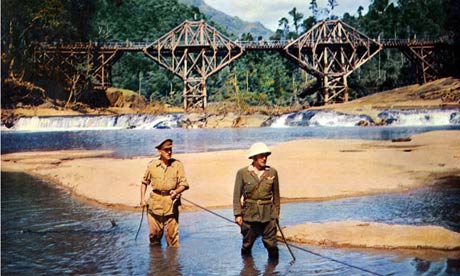
In the largesse that was the Second World War, certain conflicts will spring almost immediately to the mind of the average American. These include, on the Western Front, battles such as D-Day, The Invasion of Italy, Operation Market Garden, and the Battle of the Bulge. If you’re lucky, they may also have heard of Stalingrad, The battle for Berlin, and…perhaps even El Alamein! In the Pacific theater the average American has probably heard of Iwo Jima, Midway, Pearl Harbor, Guadalcanal, Okinawa, and perhaps the leaving, and subsequent retaking of the Philippines. The common theme of these battles, with the exclusion of a few Soviet ones here and there, and perhaps one British one, they are almost exclusively American battles, and specifically (Pearl Harbor excluded), American battles which the Americans won. This sort of common perception of World War II among Americans brings to mind for me, and certainly lends credence to a certain webcomic I read recently, drawn by Kate Beaton at harkavagrant.com which slyly noted about World War II that, “America sends its best hunks to save the Earth,” and that “Ugly people and other people may have fought against the Nazis but we can never know for sure.” It’s a very funny observation, and one that certainly has merit, and while she in this comic was referring specifically to common perceptions of WWII Europe, I think it’s even more notable in the Pacific Theater. While Americans certainly fought and died in large numbers to defeat the Japanese, what often goes forgotten is that other nations fought the Japanese during this time as well. So my long introduction brings us finally to the movie for today, The Bridge on the River Kwai, which takes place in WWII, but rather than concerning itself with the standard Nazi killfest, instead deals with the often unsung British soldiers who fought the Japanese in Burma. This movie was well known to me long before I started this little project of mine – it being a favorite of my dad’s – before this point I don’t believe I had ever seen the movie all the way through before now. Having seen it now, though, I must say, it was a very good film, and one that I am sure I will cherish fondly for a long time to come.

The movie begins by showing graves on the side of a railroad, a train passes, and we are then presented with the title screen, “The Bridge on the River Kwai. The camera then follows the train down the railroad as we pass very starved looking men working on building the railroad. The train reaches the end of the line, and we hear some very forbidding, ominous music playing. We then cut to a pair of people who are sitting around digging a grave. The camera shows us that there are many, perhaps thousands, of similar graves in the area. The two stop when a Japanese officer arrives, one of the two men, an American, attempts to bribe the Japanese officer to get the two of them onto the sick list. The Japanese officer takes the bribe, and then leave. The American then returns to grave digging. He gives a sermon for the dead soldier, whose name, rank, and life he could not remember. We are snapped from this peaceful reverie with the arrival of a new body of soldiers, marching in orderly fashion, and whistling the famous, easily identifiable tune of this movie. The regiment arrives in a prison camp, and order themselves in military fashion. The soldiers are then greeted by the head of the camp, Major Saito. Saito tells the camp that they will be building a bridge over the River Kwai, a bridge that must be finished by mid-May. He also tells them that hard work will be rewarded, laziness punished severely, and finally, he tells them that everyone shall work as equals. The head of the regiment, Colonel Nicholson takes issue with this, and informs Saito that forcing officer POWs to work goes against the Geneva Convention. Saito says he does not care, and that all officers must work.

Later that night, the officers meet together in a manner similar to the later-released (and unafilliated) The Great Escape, to decide what they are going to do. Nicholson believes Saito understands that officers will not work, and that an escape commission will not be necessary. The next day Saito tells the British soldiers that their officers will work. Nicholson staunchly refuses, and tensions come to a head as Saito attempts to force Nicholson to work through threats. Nicholson stands his ground though, and all the officers are thrown into the oven. Shortly after this, the American, Shears, who has been watching from the sick bay, makes his escape with his partner grave digger, and a British officer. The officer and the grave digger were shot and killed, and Shears was pushed off a cliff and into the river. Meanwhile at camp, the officers languish in the ovens and the soldiers work to sabotage the bridge, Saito begins trying to reason with Nicholson, but all of his threats and bribes were turned down; he will not back down on his principles. Finally, the threat of a much delayed bridge forces Saito to stand down, he relents and lets all the officers out with the promise of not forcing them to work. Meanwhile, we learn that Shears survived the fall and wound up in a Burmese village, where he is nursed back to health, and sent on his way. After a long journey, he is picked up and brought to the city of Colombo in Ceylon. There he has been relaxing for a number of weeks before he is met by a British officer who wishes to see him about what he saw in the prison camp.

Meanwhile, Nicholson has taken a survey of the bridge, and determined that the Japanese are doing it all wrong. He decides that the British are actually going to build the bridge, and that they are going to do it right. They tell as much to Saito, who has broken over losing out to Nicholson, and has collapsed under the pressure of finishing off schedule. Back in Colombo, Shears visits the British officer, and discovers that he is part of a covert ops regiment, and they want to blow up the Bridge on the River Kwai, and therefore need his information about the terrain around the prison camp. The officer tells Shears he will have to go with the squad to help direct operations overland. Shears, who we learn is a coward, tries to get out of going back into action, but the British officer forces him to. After assembling a squad, the troops land in Burma, losing one of the 4 squad members in the drop. The men decide to continue all the same, and so they make their way to the camp. After some time marching through jungle, and the serious injury of the head of the squad, the men arrive at the camp, just in time to see the bridge finish, with the first train set to be passing over on the next day. The squad set up explosives, but Nicholson, who has come to see the bridge as his legacy, sees the charges and warns Saito. Eventually Nicholson, Shears, Saito and all but the injured officer are killed, but the Bridge is blown up, by Nicholson as with his dying gasp he falls on the plunger.

The acting in this movie is absolutely fantastic. Alec Guinness, who plays Nicholson, is absolutely fantastic. I love the very subtle change that overtakes him throughout the course of the movie. He starts out as a lofty and principled British officer, who chooses to save his battalion by surrendering. He’s principled, he believes in order, making sure his men remain forever soldiers, and strongly believes in the tenets of the Geneva conventions. However, by the end of the film, the bridge begins to override everything he once held dear; eventually forcing the officers to work after all, and finally, even forcing the sick to work on the bridge. The end of the film, in which Nicholson finally realizes this change is touching, and really is the climax of the film.

I also rather liked William Holden, who plays Shears. The sign of a great coward in film is one who you think may be a coward, but are not entirely sure of. Anyone can go on camera and just try to run away and say standard cowardly things like a large ham, but a great coward is one where you think he or she may be a coward, but are not entirely sure until he is forced to choose. William Holden plays his role like this. When you first meet Shears, he doesn’t at all appear cowardly, rather, he appears as someone who has been weathered by years in a prison camp, and his experience has taught him to be cautious, practical, and selfish. As the movie progresses, you begin to guess that he’s both disingenuous and a coward. This makes the climax all the better when Shears, a man who is dragged kicking and screaming back into Burma, performs the ultimate sacrifice, giving up his life in order to make sure that the mission succeeds. The change in character was both natural and very well played by Holden.

The final actor I liked in this movie was Sessue Hayakawa, who played Colonel Saito, and boy did I like him. When I first saw him, I naturally expected him to be stereotypical harsh prison guard with a character with about as much depth as a puddle after a light drizzle. This is absolutely not so, though. If anything, Saito is one of the best developed characters in the movie. Through the course of the film you can see the fear of failure, and the pressure to succeed starting to get to him. He’s not actually a bad guy, he’s just terrified of failing because he does not want to die. Hayakawa portrays this character superbly. On the front he appears to be a tough, cold-hearted killer, but you can tell that this is all a façade. One of the best scenes in this film is when Saito relents and releases all of the officers. The British prisoners return from work to see this and begin to cheer for their officers. The scene then cuts to show Saito alone in his room, huddled up and crying. It really humanizes the presumed villain, and helps show that not every Japanese officer was evil, it really humanizes the war; it was very touching.

The directing in this movie was pretty good. The cinematography was excellent; the movie demonstrates this right from the get go in the opening title, which I already described earlier on in this review. There were also a couple really cool transitions in the movie, for example one scene in which the camera pans from the action to the sun, and then from the sun down to another scene, it was very effectively done. The explosion scene is very cool, definitely a nice explosion, and watching the train going over the bridge at the end was very satisfying; making it seem like what the agents died for was not in vain. Director David Lean does an especially good job with the scene in which Shears and another agent are setting the charges on the bridge. This scene is contrasted by a scene of the British soldiers celebrating the completion of the bridge which Lean shows concurrently, cutting back and forth between partying and setting charges. What’s really neat about this is that the charge laying makes a scene which should be joyous and euphoric into a scene of tenseness and irritation. Additionally, this splitting has the benefit of making the charge laying scene all the more tense by taking you away from the action, leaving you to guess whether or not they’re going to get caught, and puts off the answer for another few minutes. It was really awesome. Additionally, Lean makes excellent use of dramatic irony in this film at the end, when Shears and his compatriots arrive at the bridge and it appears as though the Japanese have coerced the British and are abusing them harshly, when in reality the British under Nicholson have basically taken over the camp, and want to build a bridge to last for generations to come. This irony is better still because, even though Nicholson is acting traitorously by aiding and abetting the Japanese, you still feel sympathetic to his cause, and at least in some ways, want the bridge to last as well. This means that when the time comes to blow up the bridge, you still aren’t entirely sure who you should be rooting for, it’s very effectively used irony.

I also like the way in which this movie seems to be a number of different movies at once. At the beginning of the film it appears to be an escape film. Then as it progresses it appears as though Kwai is going to be about a regiment of British soldiers enduring the harshness of Japanese atrocities common in POW camps during WWII. Then it appears as though it’s going to be an escape film again, detailing the escape of Shears. THEN it appears as though the film is going to be about how the British prisoners saved the life of Saito by building his bridge, and the repercussions. THEN it turns into a standard action film as a reluctant Shears joins up with covert ops troops to take out the bridge. THEN it turns into some kind of action film with the underpinnings of some kind of romance between Shears and his Burmese guide, and between another operative and his Burmese guide. FINALLY, the film turns out to be a tragedy as most of the main characters are killed off in spectacular fashion.

This was an awesome film. It had everything you can expect from a film of its type; good action, entertaining dialogue, great pacing, and a whole bunch of tension. I believe this film was on the list for a number of reasons. The first is awards. This movie won 7 Oscars, which is an incredible number by any reckoning. Moreover, this film has one of the most iconic tunes that exists today; one of those tunes that everyone knows, but not exactly where it came from. But above all that, this movie is on the list because it is a damned good film. Not only is it of high technical quality, but it is enjoyable to watch, and any time a movie can be good critically and be a joy and a pleasure to watch, it is definitely deserving of praise.
Read More
Posted in | No comments

Wednesday, February 2, 2011

#32 Casablanca (1942)

Posted on 11:31 PM by Unknown


Casablanca (1942)

"Here's looking at you, kid"

We’ve finally arrived at the big one. Casablanca is one of those movies, akin to Citizen Kane which is widely considered to be among the top five greatest movies of all time. This was another of those movies which are just plain great movies which I hadn’t actually seen until I started this list, although I am remiss to admit it. This is, as I said, because I absolutely abhorred black and white movies until relatively recently, and once I started liking black and white movies, I never was able to get around to watching it. A desire to see this movie, alongside such classics as Citizen Kane and The Maltese Falcon was the primary reason I started this list in the first place. Now having seen the film, I must say it is a superb film, and has not only met every expectation I had going into the film, but surpassed them handily. This is, simply put; among the greatest films I have ever seen.

1942, the world is engulfed in a World War. We are told that many Europeans caught under Nazi rule are trying to flee to America, but the going is tough. The easiest way out is through Portugal, but getting to Portugal is no easy matter, and so many refugees are taking a more roundabout route, generally from Marseille to Algeria to Casablanca, in Unoccupied France, and from thence to Portugal, and while getting into Casablanca is easy, getting out can prove to be a much more difficult venture. After this introduction, we are thrust straight into the action as recent murders have rallied the police who are racing through the streets, rounding up the “usual suspects”. One man is gunned down after he turns out to be carrying out of date papers. We are then taken to the arrival of some planes, which we learn are carrying a number of German high brass, looking for someone. The head of Casablanca, Captain Renault welcomes the Nazis to Casablanca, and they leave the airport together. After this we are introduced to our main character, Rick. Rick is an American, who, like many residents of Casablanca, has been stuck in the town, unable to receive visas to leave the country, and so he has given up trying to get away, instead opening a cantina which has become one of the most popular bars in town. Rick is a cynical, selfish man, who “never sticks his neck out for anybody”. Rick, we find, is well acquainted with Renault, who informs Rick that a freedom fighter, Victor Laszlo, who is highly wanted by the Nazis has recently arrived in Casablanca, and is presumed to be on the lookout for visas so that he may flee to America. He is also told that one Major Strasser has arrived from Germany with the intent of not letting that happen. Later on in the night Rick comes into the ownership of some visas which had been stolen recently; visas that are irreversible, can be given to anyone, and would guarantee passage out of the country. Sometime after this happens, Laszlo enters the cantina with his wife, Ilsa Lund. It turns out that Ilsa knows Rick very well, as we learn in a flashback that Ilsa and Rick had been lovers in Paris before the Nazis arrived, they had even talked of marriage, but when the Nazis arrived, and Rick asked Ilsa to flee with him to Casablanca, she left him waiting in the rain at the train station. This, we learn, is the reason for Rick’s extreme apathy and selfishness; we also learn that in spite of her slighting him, he is still madly in love with the woman.

Laszlo tries a variety of methods to get himself and his wife out of the country, but are stopped by Renault and Strasser. Eventually Strasser decides that Laszlo is too dangerous to be allowed to live, and so pressures Renault to arrest and execute him. Ilsa, meanwhile, visits Rick and attempts to get the visas he has, by force if necessary. Rick threatens her to shoot him, but Ilsa cannot do it; she still loves him. Later that night, Laszlo is arrested, and Rick, the jaded freedom fighter who never sticks his neck out for anyone embarks on a plan to rescue him and get both he and his wife out of Casablanca. After a number of crossings and double crossings, Rick gets Laszlo freed, and takes Laszlo, Ilsa, and Renault (who he is holding at gunpoint) to the airport, with Strasser right on his tail. Although Ilsa and Rick love each other deeply, Rick realizes that Ilsa is Laszlo’s motivation for fighting, so he tells Ilsa to go with Laszlo to Portugal. Reluctantly she leaves, following Laszlo into the mist. Shortly after their plane takes off, Strasser arrives on the scene to confront Renault and Rick. Rick shoots Strasser, but Renault, another man who has never stuck his neck out for anyone, covers for Rick, and the two of them flee the country together, Rick saying those eternally famous lines, “Louis, I think this is the beginning of a beautiful friendship.”

The acting in this movie is simply stunning; it’s hard not to be so with such legendary actors as Humphrey Bogart, Ingrid Bergman, Paul Henreid, and Claude Rains. Everyone in this movie was good. Bogart, who plays Rick, was superb. You really see him as a cynical, selfish man, who hates the world and everyone in it, but at the same time you can really feel the underlying drive behind this philosophy; you can feel the pain of being literally left out in the rain by Ilsa. What I loved even more was his change from selfish man to selfless man, as his reawakened love for Ilsa drives him to stick his neck out for more and more people. It’s a very touching change. Bergman was equally good as Ilsa. You can see she cares deeply for her husband Laszlo, but you can also feel the underlying love that still remains for Rick. Perhaps the most moving moment in this movie is when Ilsa has Rick at gunpoint, trying to get the visas out of him. Rick challenges Ilsa, daring her to shoot him, but ultimately she cannot and breaks down in his arms. It is an extremely moving scene, and one that made the movie for me. What’s even greater than the two actors is the incredible and oft-noted fantastic chemistry between Bergman and Bogart. I don’t feel that I can aptly describe it for myself, but it was just outstandingly good, and will probably serve as the metric with which I rate romantic chemistry in movies from here on out. I liked Paul Henreid as Victor Laszlo as well. He conveys his character extremely well, and I could see him actually being a freedom fighter, so moving were his speeches and the way in which he carried himself. Finally, is Claude Rains, who played Renault. I think he was my second favorite performer in this movie next to Bogart. He plays his character with such gusto; showing a man in many ways similar to Rick in his apathy and general unconcern with the problems of the people in town were conveyed very well. Unlike Rick, however, Renault carries underneath the heart of a pragmatist, a man who sees opportunity in a town in which everyone needs his help, and is perfectly willing to exploit this position. So while he is friendly and affable towards Rick, at the same time he is cruel and mean to just about everyone else. Beneath all of this, however, he has a soul. Although he gives the sense of unconcern, he truly does care for the plight of the people, or should I say certain people. When he delivers those lines at the end of the movie, “Major Strasser has been shot. Round up the usual suspects.” I must say my mouth was agape for a good 5 minutes afterwards, that’s how great of a “Crowning moment of heartwarming” it is. Rains carries the complexity and contradiction inherent in Renault very well and very believably.

The directing in this movie is just as good as the acting, if not better. This movie was directed by the legendary Michael Curtiz, who is on a number of other movies on this list, such as the already reviewed “Adventures of Robin Hood”, which I have already reviewed. The cinematography in this film is fantastic. In Robin Hood I mentioned that, while the scenes are for the most part well shot, the shooting isn’t a major player. In this movie we see something wholly different. Everything in this movie is very cleverly shot. One scene I particularly like is the introduction of Rick. The scene starts at his hand, which signs his name to a bill, the camera then pans up until his whole face is shown. Even better than this is the lighting in this movie; just like in Robin Hood, Curtiz really likes to play around with shadows. I really like the way Curtiz plays with shadow and lighting in this movie to tell a story outside of the actual story. It is a facet of this movie which I don’t think I can adequately describe on paper, so I will just trust you to see it for yourself. I also really liked the pacing in this movie, namely, the contrasts. What I mean is that Curtiz has a manner of delivery in which he gives us a calm, serene scene, and then immediately contrasts that with a break marked by action and noise. It’s jarring, but also very well done; on the whole it’s very good.

The writing in this movie is just fantastic. The pacing is great; there was never a moment in this film in which I found myself checking the clock. There’s a nice flow of story, and it never really bogs down, which is awesome. What’s more is the movie tells a very compelling and epic story in a mere hour and a half. Another great thing about this movie is the dialogue. There are so many classic lines in this movie; that’s a given, but even better are little pieces that are just as good. One example is a German couple who’s finally gotten leave to go to America, and they explain that they are speaking exclusively in English now. Then one of the asks, “What watch?” referring to the time, to which the other replies, “10 watch”, little things like these make the movie for me. I also really like the casting in this film. What one may not realize is that the vast majority of this cast is European; in fact only 3 actors in this movie are American. The fact that the movie employs a wide range of actors and extras from all over the world really helps contribute to the “melting pot” feel of Casablanca that Curtiz was going for.

Finally, I loved the music in this movie. “As Time Goes By”, which comes to be the thematic linking music of the whole movie, is just wonderful and heartwarming. Added on to this is a lot of jazz, and I love jazz, so those moments were very good. On top of these is some wonderful loud ominous brass sounds mixed throughout, which really help contribute to that Curtiz style of sharp contrasts. It’s all just wonderful.

I don’t really feel like I need to say why this movie is on my list. A quick visit to Casablanca’s IMDB page will tell you as much immediately. It is considered by many to be somewhere between the 1st and 4th greatest movie ever made, intermixed with Citizen Kane, The Maltese Falcon, and The Godfather. 7 or 8 of the lines in this movie are listed among the best in film. Moreover this movie has become legendarily famous for the powerful performances of Bogart and Bergman and the magical chemistry they bring to the whole thing. Everything about this movie, from the acting, to the directing, to the music, to the pacing, to the writing, to the dialogue, even to the editing is absolutely flawless. Simply put, this movie doesn’t just live up to the hype, it exceeds it.
Read More
Posted in | No comments

Monday, January 31, 2011

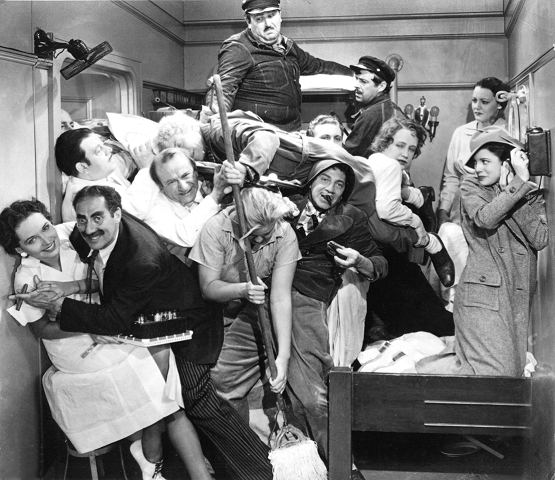
#31 A Night at the Opera (1935)

Posted on 5:09 PM by Unknown

A Night at the Opera (1935)

" Hey you. I told you to slow that nag down. On account of you I almost heard the opera."

I love the Marx Brothers. I have for quite some time. This fact is quite remarkable in that my love of the Marx Brothers goes back at the very least to 7th or 8th grade, a time in which I disliked most old movies, and despised black and white. And yet in spite of this severe dislike of old movies, my love of the Marx Brothers remained. The first Marx Brothers film I can remember watching was the one I am reviewing right now, that is, A Night at the Opera. I have tremendously fond memories of this film, being not only my first experience with The Marx Brothers, but also being my favorite of the films they made. This fact caused confusion when voiced to a friend of mine, who couldn’t see how I could possibly like any Marx Brothers film more than Duck Soup. And while Duck Soup is a superb movie, the jokes are hilarious, and the three are in top form, A Night at the Opera brings something more, and that is an actually perceivable plot. While I’m sure there are many who would disagree with my viewing this as a good thing, I actually do, and it is my hope that by the end of this review you will too.

The film starts out with a scene at a swanky restaurant. Mrs. Claypool is waiting for the arrival of Otis B. Driftwood (Groucho), who is serving as her manager, charged with getting her into high society. Mrs. Claypool is upset because Driftwood has not yet achieved this feat, and he doesn’t appear to be putting any effort at all into the job. Driftwood interrupts her with a plan, by providing a large donation to the New York Opera, owned by Gottlieb; she will be instantly entered into high society. The two talk with Gottlieb, who tells Claypool that he will use the money to hire an opera singer named Lassparri, who is renowned as the greatest tenor in the world. Claypool and Gottlieb then visit the opera house where Lassparri is performing to see his talents, and hopefully hire him for the upcoming New York opera season. We are soon introduced to Lassparri, who turns out to be an arrogant, vain, and rude person. Lassparri, as it turns out, is in love with his female counterpart at the Opera, a woman named Rosa. She, in turn is in love with a man named Ricardo, who is a powerfully talented tenor in his own right, but just doesn’t have the right connections and notoriety to make it big. Ricardo meets with an old friend of his, named Fiorello (Chico), who vows to help him make it big in the Opera. The opera is performed, and Gottlieb and Claypool are sufficiently satisfied sign him for their own opera. Lassparri elects to take Rosa with him as his counterpart. The two depart, alongside Driftwood, Claypool, and Gottlieb on a steamer ship bound for New York. Shortly after settling into his cramped quarters, Driftwood soon discovers that Ricardo, Fiorello, and Lassparri’s recently fired assistant Tomasso (Harpo) have stowed away in Driftwood’s suitcase. After some crazy antics, the three stowaways are discovered, incarcerated in the brig, and subsequently escape, sneaking through customs into New York City. This escape is discovered, and the three spend the rest of the film evading police while attempting to get Ricardo into the Opera, which, through a complicated series of antics and machinations, they manage to achieve. At film’s end, Rosa and Ricardo sing a powerful duet, resulting in the disgracing and outturning of Lassparri, the successful union of Rosa and Ricardo, and Ricardo’s grand entrée into the opera scene.

The acting in this film is simply superb; the Marx brothers are in top form for this movie. Groucho’s lines are quick, witty, and uproariously hilarious. Chico is punny and riotously funny. Harpo is equally superb, though not quite as prominent as he was in others of his movies such as Duck Soup or A Night in Casablanca. The chemistry of the three Marx brothers is fantastic. Watching Chico and Groucho riff off one another is among the greatest comical performances of all time. But the Marx Brothers aren’t the only great performers in this film. Rosa (Kitty Carlisle), and Ricardo (Allan Jones) are both very compelling. The story of their romance, serving as a sort of undercurrent of the plot of the film is wonderfully performed. Also notable are Walter Woolf King, and Marx Brothers staples Margaret Dumont and Sig Ruman who give excellent performances as straight men to the Marx Brothers. Walter Woolf King, who plays Lassparri, does a good job conveying the arrogance and vanity of his character, while also inviting an opportunity for sympathy for a spurned lover. Margaret Dumont, who plays Mrs. Claypool has been in a number of Marx Brothers films, including Duck Soup, and was excellent as always, serving as a platform for a number of insults from Groucho with appropriate indignation. Sig Ruman, who has also performed in several Marx Brothers films such as A Night in Casablanca, provides another sufficiently entertaining straight man, though I must say I preferred him in Casablanca, where he played an excellent straight man to Harpo. Nonetheless, it is not the Marx Brothers alone that make for an effective comedy; a good comedy requires an equally good straight man (or men), and A Night at the Opera achieves this end superbly.

The directing in A Night at the Opera is surprisingly very good. There are some very good shots in this movie, the most prominent in my mind is a very funny scene in which the Marx Brothers evade and confuse the head of police in New York by running around a two-room apartment. The cool shot I am referring to is when the camera draws back to show you the layout of the whole of the apartment, allowing you to see just what exactly all of the brothers are doing at one time without having to constantly cut around. One thing I particularly like about this film is that it feels improvised. For all I know it could have been, but the sense of the film is that much of it is done in one cut and many of the characters appear to literally be riffing off one another; coming up with jokes and retorts on the spot. Whether or not this is the case is irrelevant, the feeling it achieves makes the film all the more entertaining. One thing I am disappointed by in this film was the editing, which was not very good, and there are a lot of mistakes and poorly cut shots, resulting in repeated actions throughout the film. However these bad edits for the most part are either ignorable or simply add to the general hilarity of the film.

As I intimated earlier, I consider this movie to be superior to the earlier Duck Soup for the reason that it has an actually coherent plot. There are many who would disagree with me; many allege that the Marx Brothers are weakened by plot, which only serves to distract the movie from the hilarious antics of the brothers. This is simply wrong. Viewers need direction, they need to have a sense of where the movie is going, a goal for them to root for, and characters who are striving for an end which will result in euphoria in the viewer in the end is achieved, or sadness or catharsis when the end is not achieved. When this direction is not there; when the viewer is unsure of where the movie is going, the result is drag. The movie gets muddled, viewers get bored, and things such as checking run time against the DVD’s clock start happening. This is apparent even in a movie as good as Duck Soup, where, even though you are laughing from start to finish, you simultaneously find yourself looking for the end. This is not so with A Night at the Opera. The characters have a goal – for Lassparri it is to successfully perform in the New York opera, for Crawford it is to put on a successful opera and achieve status, and for Ricardo and the Marx Brothers, it’s to get Ricardo’s great talent as a tenor recognized by the general public. The result of these cogent goals is a superbly paced movie, and what’s more, I don’t feel there was a shortfall in antics. The flow of this movie is excellent, and I enjoyed myself from start to finish, and most importantly, I didn’t find myself checking the runtime.

Almost as excellent as the superb jokes of the Marx Brothers is the music. The performances of the extremely talented Chico on Piano and equally talented Harpo on Harp are a staple of Marx Brothers films and are performed stupendously in this movie. These two, however, are further aided by a wonderful cadre of singers, notably Allan Jones as Ricardo, who performs a trio with Chico on Piano, Harpo on Harp, and he singing. Equally compelling are the two or three duets between Allan Jones and Kitty Carlisle. These are all superbly beautiful performances. One potential shortfall of this film is you’re probably going to have to at the least be ambivalent towards Opera as there is a lot of Opera singing in it. Luckily for me, I adore opera, and greatly adored the Verdi music laced throughout the movie. For me the intermixing of Marx comedy and Verdi opera music was a match made in heaven.

So why is this film on the list? Well for one, you just have to give the Marx Brothers some love. To leave them out of a list of greatest and most influential film of all time would be akin to leaving out Charlie Chaplin or John Wayne; their great volume of work, and great notoriety as prolific actors and pioneers of film cannot be understated. Moreover, A Night at the Opera signified as monumental shift in Marx Brothers films, away from the undirected (and less popular), non story driven films like Duck Soup, and a change towards films containing story, usually featuring a pair of secondary characters who help to direct and keep the film moving. There are many, such as Roger Ebert who this as the end of the Marx Brothers, but I see it as the rebirth. There is a reason why I consider A Night at the Opera to be their best work; it is the great combination of the dialogue, jokes, and chemistry between the Marx Brothers with a cogent storyline to keep the viewer engaged which makes this such a great movie, and one which deserves to be placed on any eternal list of great movies.
Read More
Posted in | No comments

Friday, January 28, 2011

#30 The Leopard (1963)

Posted on 7:41 PM by Unknown


The Leopard (1963)

"We were the leopards, the lions, those who take our place will be jackals and sheep, and the whole lot of us - leopards, lions, jackals and sheep - will continue to think ourselves the salt of the earth. "

One of the great things about going to college is that in the course of taking classes, I on occasion get to watch great films in-class, and even greater is that once in awhile these films happen to be movies off the list. This means that before I even start writing about the movie for my blog, I’ve already written rather extensively on it in that class, therefore making it much easier to convey my thoughts on the movie when the time comes to talk about it on my blog. This has happened on a number of films for this blog, such as with The Earrings of Madame de…, and Pather Panchalli. Sometimes I am introduced to the film through the class, such as when a movie is recommended to me offhand by a professor during lecture, as has happened with films such as Metropolis and Blade Runner. This unexpected advantage of being in college classes has proved extraordinarily helpful for me in choosing which movies to watch next, considering the arbitrary and unsystematic way in which I go about watching movies off of my list. The movie which I will be talking about today, The Leopard, directed by Luchino Visconti, and starring the legendary actor Burt Lancaster. So this is a movie, which in many ways bears the trappings of a Spaghetti Western, but it is much more, much much more. I think now would be a very good time to mention that for the first time since I reviewed Dracula, we are looking at a movie whose base work I have actually read.

The movie opens with the vista of an Italian Villa, which eventually pans, balcony by balcony, across the house until we are shown a room full of people saying mass. We can hear something going on outside, but the people keep to their mass. Eventually mass is concluded, and the lord of the manor, one Prince of Salina, is informed that there is a dying soldier outside, who came to the estate to announce that Giuseppe Garibaldi has landed in Palermo with an army of 800 redshirts (no, not those kinds of redshirts). Salina decides to ride off to Palermo in spite of this, which, we learn, was essentially to see his mistress who he keeps in Palermo. The next day Salina returns to his home, and, as we are shaving, we are introduced to the character Tancredi, son of a prominent family, but left impoverished. Tancredi, we learn is a highly ambitious man and this ambition will become a central part of the film. Salina is Tancredi’s nephew, and he is a nephew who he respects and loves as a son. He talks to Tancredi about Garibaldi, and Tancredi reveals that he’s going to join the Garibaldini, saying that “Things must change in order to remain the same.” After Tancredi leaves, but not before we are informed by the family priest that Salina’s oldest daughter Concetta is in love with Tancredi (who would be her first cousin), and she is nearly certain that he feels the same. The ever perceptive Salina tells us that this cannot be so – Tancredi being far too practical to marry someone of such small fortune. We are next taken to an extended scene displaying the insanity and horror that was the battle of Palermo. This scene feels like a Spaghetti Western, showing large amounts of soldiers running around shooting at each other. It’s a very manic scene, and one that is hard to figure out what is happening, which I suppose is the point. This scene ends very abruptly as we are returned to the regal Salina family, riding through the countryside on their way to their summer estate of Donnafugata. They are accompanied by Tancredi, who has been injured and decorated by the Garibaldini.

We are next introduced to the major players in Donnafugata – the mayor Don Calogero Sedara, a miserly social riser who represents the new upper class taking advantage of the revolution – a man without taste, class, or honor, and serves as a complete contrast to the regal, chic Salinas. Besides him is his daughter, Angelica, a woman of considerable beauty and wealth. Finally, there is Ciccio, a simple man who is the groundskeeper of the Salina estates at Donnafugata. We learn that he is extremely loyal to the Salina family and the old monarchy, and Salina cares deeply for the man, even though he considers the man too lofty in his principles, incapable of seeing the grand picture.

While in Donnafugata, Tancredi sets his eyes on Angelica, much to the chagrin of Concetta. Salina is pleased to see his nephew make such an advantageous selection, and offers his support to his nephew, who is now going away again to fight in the wars being waged by Piedmont-Sardinia for the unification of Italy. While this is going on, the town of Donnafugata is taking a vote to be incorporated into Piedmont, and we learn that the vote is drawn at 100% voting yes, with 0 votes no. An odd number, and we soon learn through Ciccio that the votes had been altered by the unscrupulous and ambitious Calogero. Eventually Tancredi returns as a captain in the army of Piedmont-Sardinia and marries Angelica. Eventually we are cut again, to several years later; the Salina family is attending a swanky ball, accompanied by Tancredi, Angelica, and Sedara. For 30 minutes we are lambasted with glorious images of splendor, fantastic costumes, and wonderful dances. Contrasting these images is a Prince who is mired in depression, wallowing in the changing of times. He contemplates his death, and for many scenes you find yourself expecting him to collapse on the spot. Finally, the ball ends, the various parties clear out, and Salina, a relic from a past age, and slowly, he walks home alone.

The acting in this film, I must say is simply superb. Burt Lancaster is fantastic. Salina is haughty, arrogant, cynical, and is marked with a very sharp temper; he doesn’t take kindly to those who cannot do their job. In many ways he represents a thoroughly unlikeable character, and yet Lancaster brings such a presence, and air of extreme grace and culture, his demeanor and carriage are such that he makes the character of Salina into a thoroughly likeable character. It is an absolute joy to watch him performed. Not only that, but the scenes at the ball stand as such a sharp contrast; he’s worn out, visibly tired, and moreover, left jaded by the progress and changes the unified Italy has brought to him and his family. He is a broken man, and it is apparent, and Burt Lancaster makes it that way. The contrast to the affable, cynical Salina of earlier scenes is stark, and watching him move around, appearing as though at any minute he will collapse is just saddening. Alongside Lancaster is Alain Delon, who plays Tancredi. Delon is equally good in his role. Tancredi’s character is a conflict of a seemingly optimistic naïveté, a ruthless ambition, and an extremely perceptive sense of realism. Delon really captures this role nicely. At one moment Tancredi is jovial and jocular, and at the next he is perceptive and staid, and Delon is able to achieve these minute transitions believably. The chemistry between Delon and Lancaster is superb. The dialogue enacted between the two is light and compelling. As for other major actors, I liked Rina Morelli, who played Salina’s wife. At times she borders dangerously on obnoxious overacting, but for the most part she skirts this fine line nicely, keeping more believable than obnoxious. Paolo Stoppa, who plays Don Calogero, was pretty decent. He’s very oafish, but at the same time you can see beneath the oaf a very shrewd and conniving man. Half the time I found myself waiting for him to wring his hands and laugh maniacally, though for the most part this is generally subtle enough to be entertaining. The other major actress of this movie is Claudia Cardinale, who is in a number of other films in this list. Her performance I found to be a bit touch a go. At times she’s believable and entertaining, being sexy and seductive, while underneath showing a shrewd and ambitious girl seeing an opportunity at social prominence, but at other times her performance tips towards overacting, particularly the scenes during and immediately following Tancredi’s proposal. On the whole she came off as annoying, and while in some places that’s a good thing, usually it was unpalatable. Thankfully, the brilliant performance of Alain Delon made the scenes involving Angelica entertaining enough for me to get through.

The directing work in this film is superb. Visconti does an excellent job with the camera work, which is clever, artful, but most importantly not overbearing. There are a number of fantastic scenes involving moving-camera techniques, akin to those of Max Ophüls, but Visconti also knows when to let the gorgeously stunning Sicily landscape do the work for him. One scene I particularly like in the movie is when a servant is sent to notify the Salinas of something. The camera is set up looking down the hall, and we are watching the servant’s back as he walks down the hall, each door revealing the immense size of the hallway. This scene is very striking and shows the great wealth of the Salinas spectacularly. Another scene I liked was Tancredi’s introduction into the movie. We are shown the Prince of Salina shaving, when Tancredi’s face appears in the shaving mirror, representing both Tancredi’s ambition to achieve the wealth and prestige that his uncle as achieved, while also representing the Prince’s viewing of Tancredi as himself at an earlier age. It’s a very effective scene at showing the dichotomy of the two men, before any words have been spoken. I also very much love the costuming of this film. The suits are wonderful, and the dresses are superb. Everything is very well done.

The writing for the most part is very good. Being a huge fan of the novel, I am happy to see it being given such a good adaptation. Although the overall theme of the story has been changed – Lampedusa’s novel being focused on a longing look back at days long past as opposed to the movie’s more progressive and optimistic look towards future opportunity. Although the changing of the times is indeed sad, the future is bright and paved with opportunity. This is best demonstrated in the treatment of Tancredi and Angelica’s relationship. In the novel, while there may have been affection between the two at the start of the marriage, Lampedusa openly states that the relationship was never a loving one and it fails some years later. This failure represents the incompatibility of new money and old aristocracy, and represents the deeply cynical worldview that the very regressive and nostalgic Lampedusa conveys in his novel. The movie, on the other hand is more ambiguous. Although Salina says at one point in the film, “Yes, love, of course! Fire and flames for a year, ashes for thirty. I too know what love is,” this is only the cynical viewpoint of the jaded Salina, claimant to a fairly loveless marriage. Unlike the novel, Visconti never tells the viewer what becomes of the marriage, and from their interactions at the ball, it would seem they live together happily, being more optimistic of the future and the possibilities of a unified Italy. This dichotomy can also be seen in the decisions regarding when the movie ends. In Lampedusa’s novel, the story continues on after the ball, detailing first the death of Salina’s body, and eventually his legacy as we see his fortune being squandered by his pious and aging daughters, all of whom remained unmarried, and holders of innumerable “valuable” relics, which, a priest reveals are mostly counterfeit. The movie, on the other hand, ends first with the departure of Angelica, Tancredi, and Calogero, who are happily riding home to the sound of a firing squad, their future bright. This scene is contrasted by Salina walking the streets alone, tired and worn out, but still alive, still struggling on. Though the scene isn’t by any means happy, it’s still more optimistic than Lampedusa’s novel, leaving the ultimate fates of the main characters ambiguous and open to interpretation. Even though in this sense the movie isn’t “true to the novel” it’s not an aberration. Rather, it’s an excellent reinterpretation of the story, and one which Visconti tells swimmingly.

There were only a couple problems I had with this film. The first is the inclusion of the battle of Palermo. These scenes are not included in the book, and though Visconti stated that he put them in, essentially so the viewer can see the big picture, and understand the reasoning behind the family’s trepidations regarding the Garibaldini, I do not agree. The scene looks pasted on, like it doesn’t fit, and worst of all, it drags. I feel the movie could have done much better without it. The other problem in this film is with the ball scenes. These final scenes of the film take up 30 minutes of the film in the dubbed version, which is the [i] short version [/i]. Although these scenes are extraordinarily powerful, and the costumes are gorgeous, it still drags. I feel as though if about 10 minutes of these scenes were cut (which they easily could have been), it would have been a much better experience, but that’s just me.

This movie is very, very good, but why is it on the list? It may not be a perfect film, but it’s still very good. I feel this movie is on the list on the first part because of the names. Luchino Visconti, Burt Lancaster, Alain Delon, and Claudia Cardinale are all names which appear on this list of mine several times. Not only that, but all these names (a few times excepting Claudia Cardinale) are all at the tops of their games with this film. That may play a role in it, but I think it’s more for the strength of the film’s adaptation. When this film came out the novel had only been out for about 6 years, with Lampedusa having died shortly after the publication of his novel. This leaves little time for interpretation of the novel, and moreover, there’s no author to provide insight into the book, and as we have seen with such adaptations as Harry Potter, Eragon, and the Golden Compass, even with the author of the book there overseeing and playing a large role in the writing process, it’s very hard to adapt a novel into a movie and make it work. With The Leopard, Visconti manages to adapt the novel fantastically, while applying his own interpretations and making it work, stupendously. This film is on the list for being a fantastically well adapted movie.
Read More
Posted in | No comments

Wednesday, January 26, 2011

#29 Barry Lyndon (1975)

Posted on 5:08 PM by Unknown

Barry Lyndon (1975)

"You are a liar! You are an impostor. You are a deserter. I suspected you this morning, and your lies and folly have confirmed this to me. You pretend to carry dispatches to a British general who has been dead these ten months. You say your uncle is the British Ambassador in Berlin, with the ridiculous name of O'Grady. Now, will you join and take the bounty sir, or will you be given up? "

As I mentioned in an earlier review, Stanley Kubrick was for me one of those large, preeminent figures in filmmaking of whom I was aware of through his film, but in actuality had no idea who he was. It is truly disappointing that I was not aware of him before, because I have been extremely pleased by what films of his I have seen. One more such film can be added to that ever growing list – Barry Lyndon. This epic, an historical tale which netted Kubrick 4 Oscars, is an excellent film. Although I didn’t quite like as much as 2001: A Space Odyssey, it still has served to further engender myself to, and solidify my adoration of, Stanley Kubrick.

The film begins with a duel. The narrator tells us this is Lyndon’s father, who probably would have gone on to be a great man, but he is to be killed in a duel we are now watching, which began in a dispute over some horses. The flippancy and absurdity under which this scene begins the film sets the mood for how the entire resulting movie will present itself. After this scene, we are told that Barry’s mother vowed not to remarry, and instead decided to devote all of her time to the upbringing of her son, Redmond Barry. This point of the devotion of mothers to sons and sons to mothers, as well general treatment of women will come to be a very important point in this film. Redmond, we soon learn is absolutely besotted with his first cousin, and she likewise appears to be in love with him. It’s not to be, however, as she pursues a captain instead, one who will bring a good deal of wealth into her family. Redmond is so angry that he challenges the man to a duel, which Redmond wins. This duel turns out to be a farce, but nevertheless Redmond believes it to be a real duel, and so, on the advice of his friends, he is given all that his mother has, and flees into hiding in Dublin, beginning a journey that will take up the first half of the film. Along the way he is robbed of all of his money, and so looking for a source of income, joins the army, where is he is trained and sent to Germany to participate in the 7 Years’ War. After his first taste of war, he decides to desert, and ends up falling in with the Prussians. From there he becomes an aide, then a spy, and then a gambler. Through all of these pursuits he finds success, and over the course of a few years he manages to rise from being a poor Irish vagabond without a guinea to his name, to being part of the wealthy gentry in late-Bourbon France.

Part two of this film begins when Redmond Barry uses this newfound wealth and prestige to marry the recently widowed Lady Lyndon, a woman of considerable wealth, land. From this marriage, Redmond is able to take on the family name of Barry-Lyndon. Alongside Lady Lyndon comes her young son Lord Bullingdon. We learn very early on that Bullingdon is driven by a total adoration for his mother, and a strong resentment towards Redmond. We also learn that Redmond, having been made a skeptic to love early in his life due to the refusal by his cousin of his pronouncement of love to her, carries no interest or love for Lady Lyndon other than a desire to have a son and a desire to own the lands which she brings to the marriage. As such in part two we see Redmond as a man who is deeply disrespectful towards his wife, and goes on to squander nearly all of the wealth which Lyndon brings to the marriage. The last half hour to 45 minutes of the film consist of the final coup de grace of the downward spiral of Redmond’s life, as he loses everything which he holds dear, and everything which he had worked so hard to gain for himself. This begins when Lyndon fails in a pursuit to get ennobled, is followed by the tragic death of his son, who, aside from his mother, is the only person in his life for whom he truly cares. Finally, following an insult given to his step-son, he is defeated in a duel, resulting in the successive loss of his leg, his land, and finally his wife. A broken man, Barry Lyndon, we are told, fades into poverty and obscurity. We are left with the passing words of the Epilogue: “It was in the reign of George III that the aforesaid personages lived and quarreled; good or bad, handsome or ugly, rich or poor, they are all equal now.”

The acting in this film is decent, but on the whole I found it to be rather hit and miss. The character of Redmond, played by Ryan O’Neal, starts off very weak, especially in his delivery of lines for the first half hour of the film or so, but he gains strength as it goes along. Leonard Rossiter, who played Captain Quinn, the man who wooed away Redmond’s cousin, I thought was very good, as was Godfrey Quigley, who played Captain Grogan; the man who served as a close friend and father-figure in Redmond’s early life. Marisa Berenson was very good as Lady Lyndon; her grief following the death of her son by Redmond was strong and compelling. You really feel for her grief. I really felt these scenes were probably among the best in the film, especially for the primary characters of Ryan O’Neal and Marisa Berenson as, especially for Redmond, you for the first time in an hour truly feel sorry for the man. You can see that his son is the one thing he truly cares about, and you really believe it. Finally, I liked the performance given by Leon Batalli, who played Lord Bullingdon. He is haughty, principled, firm in his compassion for his mother –and firmer in his resentment towards his father. The performance he gives in his final, climactic duel with his father, which ends up being rather anticlimactic, a farce of the traditional, (sort of) idyllic, stereotypical duel which starts the film.

The directing in this film is simply superb. One thing I noticed that really shined with the actors was not how they delivered their lines, but how they carried themselves while they delivered those lines. This first occurred to me when Redmond duels with Captain Quinn. You can really see Quinn’s fear. Although he appeared arrogant and affable when he first accepted the challenge, now he genuinely feared for his life, and you could see it. It’s all very subtle, and this fact quite simply made the film for me. The pacing in this film is even better. It’s very even, and though the movie comes in at a length of 3 hours, I did not find myself looking for the end. The pacing in-scene is also very good. A great example is the duel between Bullingdon and Redmond. Bullingdon gets first shot, and he is told to cock his pistol. Things happen now rather slowly, but you don’t expect anything to go awry. Suddenly you are taken from your reverie as in his nervousness he accidentally discharges his pistol. It is a great jump, and one that really added a sudden line of tension in the film. This was quickly followed up by a slow countdown for Redmond to finish off Bullingdon, but you are once again derailed from your reverie when Redmond fires into the ground shortly after the count of two. Kubrick’s play with timing and expectation like this makes for very entertaining viewing. I also like the pacing in terms of the appearance and disappearance of characters. Redmond meets and makes many friends through the course of this film, and what I find really interesting is that many of these characters wax for a period and then drift off. It’s interesting in that there’s often no event in which the characters part ways but usually the characters just drift apart until such a time as you actually forget that Redmond knew that person in the first place. This is very true of Redmond’s character in general, who sees people as means to an end; a vector through which he can get what he wants, and once they have provided their usefulness, they cease to play a part in Redmond’s life.

Another thing I very much like about this film was the flow of music. When the film begins, even during the darker moments of the exposition, the music is light, gay, and playful. Even when Redmond is being robbed of everything he owns, the music, and the tone are upbeat. He may have nothing but the shoes on his feet, but you the viewer is unconcerned. As the film progresses, the music gradually changes. At the apex of the film – the beginning of part 2 – the music is grand, sweeping, and epic, reminiscent of Redmond as a successful, prominent, and grand figure now. By the end of the film, the music is solemn, serene, and morose, reflecting the pall knell of Redmond’s life as a gentleman; his loss and failure. Just as awesome as the music is the set design and costuming; the costumes appear very authentic, and the dress in general is just gorgeous. I’ll talk more on the beautiful backgrounds and locales used in this film a little later, but just as great as these are the luxurious and ostentatious palaces and manors. The little nuances like these are what make Barry Lyndon a great film.

Finally, and most importantly, is the cinematography. I will be frank, and say that the camerawork and framing in this film is not 2001: A Space Odyssey; there isn’t that overwhelming sense of meaning, power, and scope which is contained in nearly every shot of 2001. That being said, the camerawork is still very good. I love Kubrick’s utilization of the sweeping and gorgeous landscapes which he uses as the settings for this film. But no, it is not the camerawork that distinguishes this film. Rather, it is the lighting, which this film utilizes spectacularly and revolutionarily. What is remarkable in the lighting is that, through the use of filters, Kubrick is able to film indoor shots in old buildings with nothing but natural light. This makes for very stark scenes, from images of a dull or dim room contrasted by stark shafts of light brought in by massive windows. Even better than this were the heavily darkened rooms contrasted with small amounts of light provided by candle. Not only are these scenes as stark, brilliant, and imposing as those of 2001, but they also give the viewer a real sense of just how dark (literally) things were in the days before electricity.

So the great Kubrick impresses once again. What I find remarkable about Kubrick is the incredible diversity in film. I’ve already looked at 2001: A Space Odyssey which paints a rich and vibrant space-scape, and develops a generally futuristic feel. I’ve also looked at The Shining, which is a horrifying story of a man going insane in Colorado, and now I’m looking at this: an historical film with rich period sets and characters. Not only are the topic covered varied, but they’re all done properly. If, 4 years ago you had shown me 2001: A Space Odyssey and then shown me Barry Lyndon I absolutely would not have believed they both came from the same man. I’m starting to see now why he is put up along the great directors in film history; not only is he able to make a great film, but he can repeatedly make great films, and make them across a vast array of genres, themes, and stories, and that remarkable ability takes true talent.
Read More
Posted in | No comments

Monday, January 24, 2011

#28 The Good, the Bad, and the Ugly (1966)

Posted on 4:51 PM by Unknown

The Good, the Bad, and the Ugly (1966)

"When you have to shoot, shoot, don't talk!"

Allow me to preface this review by saying that I freakin love Clint Eastwood. I don’t think I’ve ever met anyone who didn’t. And what’s not to love? He’s cool, rather dashing, and just has a gravitas in his performance that just exudes badassery. Even watching films such as Gran Torino in which he’s acting as an old man, he’s still able to carry this swagger of a man who can easily beat you down, and both he and you know it. The movie The Good, the Bad, and the Ugly, which is the third in a trilogy of Spaghetti Westerns directed by Sergio Leone and starring Clint Eastwood, encapsulates this persona stupendously. Even though for most of my life I rather disliked the Western genre, and was loathe to watch westerns, this movie has shown me fully and completely what I have been missing out on. It is a supremely great film.

The film opens with an introduction of the three primary characters of the film. Tuco is introduced first as he single-handedly takes down 2 assailants before jumping out of a window and riding off into the sunset. Tuco is the Ugly. Next we are introduced to Setenza, who rides to a poor farmer’s house looking for information. After giving up the information, the farmer tries to buy off Setenza – attempting to get Setenza to kill the man who hired him. Setenza takes the money, and then kills the farmer and his son. He then rides off to his employer, and kills him for good measure. Obviously, Setenza is introduced as The Bad. Finally, we are introduced to The Good, played by Clint Eastwood. His introduction scene begins with a scene of Tuco riding through the wilderness, before being attacked by two bounty hunters, seeking to collect the substantial reward on his capture. Clint Eastwood, whose character has no actual name, kills the bounty hunters, and takes Tuco in himself. Eastwood collects the reward, and then rescues Tuco before he is hung. It turns out that this is a scam that Eastwood and Tuco have been performing for some time. Eastwood has had enough of it, however, and so leaves Tuco to die in the middle of a desert. Meanwhile, we find out that Setenza has learned of a large treasure of 200,000 dollars, hidden by a confederate officer. Setenza begins searching for the officer in the hopes of getting the money for himself. Tuco manages to walk the 70 miles through the desert back to town, where he steals himself a gun and vows revenge against Eastwood, who he calls Blondie. Tuco eventually catches up to Blondie, who evades a hanging at the hands of Tuco, but is soon caught again and this time is sent through the desert by Tuco. Just as Blondie is about to die, he is saved by the arrival of a wagon manned by the officer who buried the treasure, who is now on his death throes. The officer tells Tuco where it is buried generally, in a graveyard, but doesn’t tell him the specific grave, which he ends up relaying to Blondie. Having a sudden change of heart, Tuco disguises himself and Blondie as confederate officers and rides to a monastery to find medical care for Blondie. After some time, Blondie and Tuco ride off, but are soon captured by Union soldiers (they’re still disguised as Revels), and sent to a prison camp which is headed by Setenza. Setenza beats the information on the cemetery out of Tuco, and leaves him to die, and then makes an agreement with Blondie to split the treasure 50-50. Tuco gets away and rejoins with Blondie, and the two backstab Setenza, and go off to find the treasure for themselves. They reach the cemetery, after Tuco backstabs Blondie once again, and the three are then confronted by Setenza, who has been following them. The three of them then have a final showdown to determine who gets the loot. Blondie kills Setenza, and reveals that the night before he had taken Tuco’s ammo, and so makes Tuco dig up the treasure for him. Tuco strikes gold, but before the loot is divided, Blondie sets up Tuco to be hung. Leaving Tuco standing on a gravestone, hovering between life and death, Blondie rides off into the sunset with 100,000 dollars, Tuco screaming, “BLONDIE” as he departs….JUST KIDDING! Blondie comes back, and, one last time, shoots the rope holding up Tuco, leaving Tuco to his share before departing once again.

The acting in this movie is simply superb. Clint Eastwood is excellent, as is to be expected. He carries this affability that is quite fun to watch. He’s smooth and well composed, and is very confident in his abilities. At the same time, the other two lead actors are equally good. I really liked Lee Van Cleef who played Setenza. He just plays such a great villain. He’s not arrogant or haughty or dastardly. He knows what he wants, and he knows how to get it. I may not have said it before, but I really like genre savvy villains, meaning I like villains that DON’T do things such as leaving you out to die in the desert rather than shooting you on the spot, or believing your 1st lieutenant when he says that that sound you just heard was probably nothing. Setenza is a genre savvy character. When Blondie disappears after their teaming up, he assumes that Blondie is betraying him, and so sends his crew after Blondie, while making his own getaway. He was just a very cool character. I also liked Eli Wallach, who plays Tuco. I didn’t really like him at first, because he came off as annoying, and clingy, and not capable of taking care of himself. But later on in the film you begin to realize that Tuco is actually very badass in his own right. His interaction with Eastwood was very good, and watching their interactions was very entertaining. For the most part, the rest of the characters are Italian extras (hence, Spaghetti Western), and in general are not very good. One character I did like, however, was Aldo Giuffrè, who played the drunken Union Captain that Tuco and Blondie interact with towards the end of the film. He brought realness to his character that you just couldn’t help but feel sympathy towards, and I really liked that.

The directing in this film is superb. The film is set up as a deconstruction of the Western genre, that is to say, they take all the conventions, tropes, and characteristics of the genre, and exaggerate them to their fullest extent. This deconstruction is made very obvious from the very first scene which shows two cowboys walking towards one another through an abandoned town. This process takes a good ten minutes, showing them walking through town in all manner of funny and peculiar angles. Finally the two opposing forces stop, and they stare each other down for another couple minutes. The camera pans back and forth between close-ups of each actors’ eyes. Finally, the two cowboys do not attack each other, but advance together into a saloon, where we hear gunshots and a man jumping out of a window. After all of that, we don’t even see the fight. What I find even more impressive in this parody, is that the film still maintains a very serious and grave tone. It’s not explicitly funny, but when you think about the way in which the film is presented, you realize that it is very funny. Perhaps the most impressive scene of this film is the very famous “bridge explosion scene” in which Tuco and Blondie blow up a bridge separating Union and Confederate encampments, so as to get both armies out of their way. The bridge itself was constructed in full scale at very great expense, and Leone had only one chance to shoot the scene, and it is just simply spectacular. Another thing I love is the subtlety of this film. Plot elements often are not explicitly told to you. What’s very impressive is how well the characters are constructed in this film, and this is really where the subtlety comes in. Each of these characters has aspirations, pasts, and personalities that are very specific, and while they may not necessarily be apparent to a casual or passive viewer, when one pays careful attention, these elements become very apparent. I particularly like Tuco’s character, which is distrustful, resenting, haughty, and very arrogant. He doesn’t take well to backstabbing, though he happily will do it to anyone and everyone he interacts with. The motivations of these characteristics come mostly from his upbringing, which forced him into a life of crime, and though in some ways he is shown to be resentful of his selected lifestyle, he also likes it a lot.

There was really only one thing I didn’t really like about the film, and that was the pacing. The Film is 2 hours and 48 minutes long, and while I don’t particularly mind a long film, this movie goes on for the first hour without any semblance of a plot, which to me gets slightly aggravating, and though I liked what I was seeing, I found myself constantly checking the clock against the run-time. Once Eastwood and Tuco start out trying to find the treasure, though, the movie picks up in a very good way, and after that it was a much more enjoyable watch.

Overall this is just a superb film. It is a movie which I would gladly watch again and again. Sergio Leone just does a fantastic job, and Clint Eastwood is stunning. This is just flat out a cool movie. In spite of the long run-time of this film, it is very accessible. Now we enter the grand question: why is this film on the list, and more importantly for this film, why this film specifically, and not the other two? Having not seen the other two films of this trilogy – A Fistful of Dollars, and For a Few Dollars More, I don’t think I would adequately make an analysis, though I will provide what thoughts I have. I think on the first part this film is on the list at all for the fact that it stars the pairing of Eastwood and Leone, and truly represents the Spaghetti Western genre. Now, as for why this movie was selected over the two, I can’t make any commentary on the quality of this film over the other two, though I will say that this film was selected over the other two because of its influence. I am aware of the other two films, but that comes more from having a dad who is a big fan of westerns. In that sense these films don’t have wide recognition, whereas The Good, the Bad, and the Ugly, is an extremely well known and influential film; one that I would have heard of regardless of the film tastes of my father. Therefore The Good, the Bad, and the Ugly was selected over the other two films because it is more widely known, and has more cultural influence than the other two, which regardless of whether or not they are better films, are less widely known. Whatever the rate, I am very happy I saw this film, and it will definitely warrant an enthusiasm for further viewing of western films as I work my way through this list.
Read More
Posted in | No comments
Newer Posts Older Posts Home
Subscribe to: Posts (Atom)

Popular Posts

  • #17 Dracula (1931)
    Although the connotations of the concept and name “vampire” have changed massively in the last decade, especially with the advent of the po...
  • #41 Sherlock Jr. (1924)
    Sherlock Jr (1924) So here I am, sitting down in Mid-August to write the first of 6 reviews for movies I watched way back in March. Needless...
  • #16 Nosferatu, eine Symphonie des Grauens (1922)
    "A Key Work in the history of film" It can be argued that there is no story or character more adapted and done in film than vampi...
  • The Exorcist (1973)
    The Exorcist (1973) The Exorcist is a movie which has evoked the fears of every child and young adult (and even some adults) for the past n...
  • #21 Seven Samurai (1954)
    Seven Samurai (1954) "A brilliant epic" A defenseless village is beset by bandits, who vow they will return in several months’ ti...
  • The Shining (1980)
    The Shining (1980) The Shining is one of those quintessential movies. So many things from this movie are referenced, quoted, or even outrig...
  • Citizen Kane (1941)
    What can be said about Citizen Kane that hasn’t already been said a thousand times over? The Orson Welles classic about a rich newspaper mog...
  • #34 The Haunting (1963)
    The Haunting (1963) “Hill House has stood for 90 years and might stand for 90 more. Within, walls continue upright, bricks meet, floors are ...
  • Pather Panchalli (1955)
    Pather Panchali (1955) What comes to mind when you first think of India? Let me guess, caste systems, jungles, elephants, and snake charmers...
  • #37 Kind Hearts and Coronets (1949)
    Kind Hearts and Coronets (1949) "It is so difficult to make a neat job of killing people with whom one is not on friendly terms." ...

Categories

  • Citizen Kane
  • Clint Eastwood
  • Dirty Harry
  • Duck Soup
  • film reviews
  • great movies
  • Marx Brothers
  • Orson Welles
  • Rosebud

Blog Archive

  • ▼  2011 (22)
    • ▼  October (2)
      • #41 Sherlock Jr. (1924)
      • #40 Our Hospitality (1923)
    • ►  April (1)
    • ►  March (1)
    • ►  February (6)
    • ►  January (12)
  • ►  2010 (20)
    • ►  October (1)
    • ►  June (2)
    • ►  May (10)
    • ►  April (7)
Powered by Blogger.

About Me

Unknown
View my complete profile