winni peg general strike

  • Subscribe to our RSS feed.
  • Twitter
  • StumbleUpon
  • Reddit
  • Facebook
  • Digg

Wednesday, January 19, 2011

#26 The Manchurian Candidate (1962)

Posted on 6:41 PM by Unknown

The Manchurian Candidate (1962)

"An all-around cool film"

Our film for today is the Manchurian Candidate. No, not that abomination. Rather, this is the original film, starring the likes of Frank Sinatra, Laurence Harvey, and Janet Leigh, and directed by John Frankenheimer. Unlike the last couple movies we’ve done, which are films that before the point that I watched them for the list, I had not seen all the way through, this is a film I actually have seen before. I watched this film my junior year in a US History class. Unfortunately I didn’t pay terribly good attention when it was shown; I was a cocky little bastard who didn’t have time for boring old movies and the showing of a film in class merely meant a day off from doing actual work. Unfortunately I gave this same treatment to North by Northwest in the same class. But anyway, having a very vague recollection of the plot of the film, I sojourned down to the library to give this one a shot.

Thankfully I was not disappointed. The film opens to a very abrupt scene in which, we are told, takes place in Korea in 1952, we see some soldiers in a brothel, and a man, one Raymond Shaw, comes in and breaks up the boozing of the rest of the soldiers in the brothel. The soldiers reveal that Raymond Shaw is unlikeable, and basically everyone hates him. Later, we are shown a Korean leading the same division of troopers through the Korean landscape, but it turns out they are betrayed and all the men are knocked out. The film then cuts to a large image of the Seal of the US imposed on a big bass drum. There is a parade being held, we are being told by a Narrator with one of the coolest voices ever, in honor of Raymond Shaw, who singlehandedly saved his entire regiment, save two men, and is basically a badass. In recognition of his exploits, he is being presented the Congressional Medal of Honor. We later find out that Raymond didn’t ask for any of the theatrics of the parade and celebration, and they were actually put on by Raymond’s mother and stepfather as a tool to garner support for the political campaign of Raymond’s stepfather, who is a US Senator. Irate over his mother’s meddling, Raymond breaks off communication with his mother and stepfather, fleeing to New York.

But all is not well elsewhere either, as many of the men Raymond reputedly saved are having vivid and terrifying dreams, every time the same. The leader of the contingent before Shaw’s daring rescue, Major Bennett Marco tries to organize an investigation, but the military drags its heels, eventually discrediting Marco and sending him on a forced sabbatical. Eventually these recurring nightmares become serious enough for the military to take notice, and the military begins an investigation into the source of these nightmares, which reveal, through the course of the film, that the nightmares are memories of the soldiers, who have been brainwashed by soviet elements as part of a grand conspiracy to set up Raymond Shaw as a sleeper agent to perform tasks unknown. Marco is sent to watch and guard Raymond and through the rest of the film the circle of the conspiracy grows wider and wider, leading to exciting plot twists, and a climax which, I must say is one of the most exciting and tense scenes I’ve ever seen. This is just a brief overview of the plot of the film which, being a political intrigue film, is infinitely more intricate than the summary I gave, but hopefully it will suffice.

The acting in this film is decent. I think the word I would use to describe it best would be “patchy”. For example, Raymond Shaw, played by Laurence Harvey, as well as Angela Lansbury, who plays Raymond’s mother both do an absolutely splendid job in their roles. James Gregory, who plays Raymond’s stepfather, also does a good job. On the other hand, I was not over the moon about Frank Sinatra’s performance; he played Major Cosmo. While he wasn’t terrible, he wasn’t particularly great either. One performance I really liked though was Khigh Dhiegh, who played Dr. Yen Lo, the man who programmed Raymond into a sleeper agent. He plays the devious, clever, arrogant villain with such relish that you can’t help but love him.

The movie was directed by John Frankenheimer, who has one other film on my list. I thought he did a very good job on this film. The cinematography especially was superb in this film. One of the decisions I most liked in the cinematography department was in the way in which Raymond’s stepfather, Senator John Iselin is presented. At the same time as the grand conspiracy of Raymond Shaw is going on, Senator Iselin is sort of a tertiary element in the story as his rise to political prominence is displayed. Senator Iselin is set up as a mockery of Senator McCarthy, the notorious Commie hunter of the 50s. Shortly after the return of Raymond Shaw from Korea, we are shown a scene in which Senator Iselin announces that there are no less than 80 (or some similar number) card carrying members of the Communist Party in the military. His story (including the number, and where they reside) change numerous times over the course of the film, and is presented as a farce of McCarthy’s attempts to cleanse the Government of Communists in the 50s, the result of which usually were little more than witch hunts. But Iselin is more than just a farce; he is an interesting character on the side, told mostly through cinematography. And what I mean, specifically is that there are 4 or 5 scenes in which Iselin is directly associated with President Lincoln. The most striking to me was when the reflection of Iselin’s face is imposed upon a portrait of Lincoln. This camera work reveals Iselin for what he is; a man of great ambition, a man who fancies himself a unifier, of great stature and charisma, a Lincoln, in other words. Instead though, he is a farce, a mere shadow of Lincoln, and is in reality controlled entirely by his wife, Mrs. Iselin, who, as we find in ever increasing degree, is completely controlling Iselin’s every move, and every word from behind the scenes.

The writing in this film is pretty good. The story is very intricate, but presented in a very understandable manner. I like the way in which the film starts with a completely closed circle in regards to how much we know, and that circle of conspiracy expands throughout the film, with more and more characters and elements presented to us early on becoming implicated as the film goes on. It sort of felt like a season of the show 24 (in that every time they think they have the mastermind, it just turns out to be another dragon). One thing I really did not like about this film at all however is the introduced romantic interest. In the film, when Cosmo is put on sabbatical, he meets a woman on the train, and there is a very very small romantic element to the story between the two of them. While I understand that this romantic interest, played by Janet Leigh serves as a steadying force for Cosmo, allowing him to focus on the conspiracy, I really thought it did little more than distract the plot of the film, and I just found it obnoxious.

Overall, this film was really great. I liked the cinematography, and it did a really good job of slowly letting on more and more of the story, building up a great deal of tension to the thrilling and dramatic conclusion. The twist at the end of the film is downright Hitchcockian in its sheer awesomeness. Overall I think this film is on the list for a number of reasons. Firstly because of its great influence on the film genre of political thriller, a genre that this movie, if not created, at the least, established many of the leading tropes and themes presented therein. On the second, this film is on the list for the superb performances given by Laurence Harvey, and especially by Angela Lansbury. Finally, this film is probably on the list because of its sheer effectiveness in creating tension and stress and excitement. This is just a straight up cool film.
Read More
Posted in | No comments

Monday, January 17, 2011

#25 The Adventures of Robin Hood (1938)

Posted on 9:07 PM by Unknown


The Adventures of Robin Hood (1938)

"A seminal classic"

Aside from Dracula, perhaps the most done, most invoked, and most referenced character in film, would in all likelihood that of Robin Hood. From a dashing 30s action star, to a cartoon fox, a Mel Brooks parody, to…Russel Crowe, it certainly feels like every film studio and their mother has done some Robin Hood film/tv show/short or another. It is quite interesting that a character such a Robin Hood has gained such a prevalence in American society, though it is not at all surprising. The idea of fighting for the poor, the oppressed, and the downtrodden against the oppression of the rich is an idea that is very congruous with the American psyche. While not the first Robin Hood movie ever made, the one I am about to review – that with Errol Flynn, Olivia de Havilland, and Basil Rathbone, is perhaps the most famous. It is certainly the most important, establishing many of the tropes, ideas, and clichés that have become and entrenched and required part of any good Robin Hood film.

This Robin Hood movie contains the same story as basically every Robin Hood movie ever made so I’ll just give it a quick gloss job. Basically, Good King Richard is off on the crusades, and on his way back gets captured by Leopold of Austria, and Bad King John uses this opportunity to take over the realm, installing heinous taxes, and egregious treatments upon the goodly Saxons in the process. This is something for which Robin of Lockesly cannot stand, and so he pledges himself to outlawry in order to better the lives of the poor Saxons. After many daring adventures, he accrues a number of partners and companions such a Much, Little John, and Friar Tuck, and with the aid of these, and many more friends, entraps numerous nobles and tax wagons in the forbidding folds of Sherwood Forest, taking from the rich to give to the poor, in the process winning the adoration of the lovely Maid Marian. Eventually, frustrated by the clever schemes and insurgent tactics of Robin Hood, the Sheriff of Nottingham and Guy of Gisbourne hatch a clever scheme to draw out Robin Hood, involving an Archery Contest, with a golden arrow presented by Lady Marian as the prize. Naturally Robin is drawn to the contest, and is caught by John and his forces, and set to be hung immediately. Robin’s gang, with the help of Marian launch a daring rescue attempt, saving Robin, and making John again look the fool. Finally, Richard returns, Guy is killed, John is deposed, Robin and his gang are pardoned, and Robin lives happily ever after with Marian. Sound familiar?

In terms of acting this film is simply spectacular. Errol Flynn is just superb, easily one of the best movie action stars of all time. Not only are his fight scenes superb, but his delivery of lines is impeccable and the way he carries himself just exudes Robin Hood. In addition, Olivia de Havilland gives an equally superb performance. The absolutely gorgeous de Havilland does a superb job carrying Marian’s haughty initial disdain for Saxons, and her subsequent change of heart I felt was equally heartfelt, albeit slightly abrupt. This is de Havilland’s third time playing opposite Flynn, and it’s easy to see the excellent chemistry the two have. Still better than Flynn and de Havilland, I felt though, were Basil Rathbone, who played Sir Guy of Gisbourne, and Claude Rains, who played King John. They just make supremely great villains. They don’t really play the dickish evil villains that you get nowadays, it’s more the hammy, failure-prone haughty and arrogant villains of classic film, and they’re just so much fun to watch. They really define that type of villain for me.

This film was directed by Michael Curtiz, who is quite the monumental force in 30s and 40s film, directing such films as Captain Blood – another Curtiz-Flynn-de Havilland action movie, and Casablanca, and I thought he did a superb job with this film. While I didn’t think the cinematography was anything particularly eye-opening like Citizen Kane or 2001 were, there were some cool shots, such as the first film in which King John spills some wine, and the camera pans down on it, or at the end of the film when the camera plays with shadows to show the climactic action scene between Gisbourne and Robin. For the rest of it, the cinematography was efficient, and it got the point across and kept the movie moving, which is probably the most important in a film like this. One thing I really liked about this movie – apart from the absolutely spectacular musical score – was the tone. This movie is rather upbeat throughout its course. It has this very happy-go-lucky feel, and while this backfire a little in that it also for me meant that there was never any real suspense or tension in the film (I never once felt that Robin was in any real danger), it was good for the film, as the light nature of the film makes for excellent casual viewing. I really like the way the action scenes were shot. While in more modern, post-Crouching Tiger Hidden Dragon films I tend to be rather condescending on the style of constantly zooming in on the actors’ faces while a fight is occurring, in this film I absolutely love it. It is done in a modest, and sensible manner, and it really works. I also felt that the pacing was excellent in this film. I was never once bored. Additionally, I really liked the scope and scale in this film. The number of extras in this film is just mind boggling, and the sets are quite well done. Especially when you consider that this movie was made in 1938, in an era before blue screen and computer generation made epic scale a relatively inexpensive process in film, it becomes all the more astounding. While many dislike the costumes in this film, and I will admit they were rather silly, I liked them in the context of the film; they fit well with the lightheartedness of the overall film.

I think the thing I liked most of all in the movie was the dialogue. The wit, and the ability and speed with which the lines and banter were delivered in this film felt a lot like something you’d see in a Shakespearean play. The lines are just absolutely hilarious though. “Such imputence must support a mighty appetite”, or “‘Why you speak treason!’ ‘Fluently’”. It is like this for the entirety of the film, and it really contributed significantly to the tone of the film, and helped keep me engaged in the film from start to finish.

This movie I watched thanks to the University Library. I was originally going to watch it on DVD which I had borrowed from my local library, but the disc turned out to be scratched, so I watched the film at UCSC’s media center when I returned for classes. I watched it on laserdisc, and it was my first experience with the medium. Needless to say, it was a very interesting experience. To those of you who have never before used a laserdisc, it basically looks like a giant DVD that is about the size of a dinner platter (or about the size of an LP if you know what that is). The quality was about that of a VHS tape, that is to say, poor, grainy, and very jarring to those of us who are accustomed to the HD of DVD and Blu-ray. It was jarring at first, but I got used to it. What was more peculiar to me was that, like an LP, a laserdisc is double sided, and you have to flip the disc over half-way through. The problem with this is that the flipping occurred in the most arbitrary manner ever, literally the movie just cut off smack-dab in the middle of a fight scene. It was very annoying. Anyway, all media aside, I liked this film, and while it doesn’t have the artistic mind-blowosity of films like 2001 or Seven Samurai or Citizen Kane, it more than makes up for it in acting and just being a perfectly effective action movie. It encapsulates everything that the 30s action genre stood for. It’s just a great way to spend an hour and a half and not be troubled trying to figure out what a particular scene means. I’m sure I’m going to get nailed for underestimating the artistic quality of the film, but I just felt like it was a fun film through and through.
Read More
Posted in | No comments

Friday, January 14, 2011

#24 2001: A Space Odyssey

Posted on 6:43 PM by Unknown


2001: A Space Odyssey (1968)

"A movie operating on an entirely different level."

In my knowledge of monumental figures in film, there had always stood before me such directors as Orson Welles, Steven Spielberg, Alfred Hitchcock, and to a lesser extent Ingmar Bergman and Akira Kurosawa, who were directors I had heard of but never knew anything about. It is disappointing to me now to think that I didn’t know anything about, nor, to the best of my recollection, had ever so much as even heard of Stanley Kubrick. This is especially distressing, since, aside from the fact that nearly every major American-made film from the 60s and 70s was made by this legendary director, but moreover I had actually seen many of these films before. Kubrick’s presence was made apparent to me by another friend and fellow aficionado of film (does that come off as pompous as it sounds in my head?), and now that I know who he is, I see him all over the place. The movie I am about to talk about, 2001: A Space Odyssey, not only has the benefit of being made by Stanley Kubrick, but is also one of those films off of this list which I was very aware of, and referenced rather often, usually without realizing I was referencing this movie specifically (It’s amazing how well versed in movie references and plots you can be just by watching a lot of cartoons as a kid). Anyway, after finally deciding to watch this epic, I can firmly say that this film is one of the most spectacular I have seen. It is, truly, a movie on another plane above many of the films I’ve watched already.

Alright, so let’s get down to business. The film starts off very peculiarly; nothing but black screen for a good 3 minutes. At first I actually thought the DVD was broken, but then the music starts off, and you’re left staring at a black screen with very eerie, discordant music playing in the background. Finally, after what seems like ages, you are given the film credits. I really like the way in which this is presented, and it really sets the standard of Kubrick’s directing style for this film, which I’ll get into in a lot greater detail later in this review. So anyway, after the credits are finished, we see our first picture in the film: the classic music of this film rolls, and we are presented with a space image of Earth, which the camera moves over, gradually revealing the sun. Finally, we’re taken down to Earth for “The Dawn of Man”. In these scenes, we are presented with ape-looking men, costume designs that reminded me very much of the ape-suits from Planet of the Apes, which I reviewed earlier this week. These scenes are typified by a lot of spectacular long shots. One thing I found very fascinating about these scenes was that although no dialogue, no actual human characters or human-like characters, and no discernable story was happening in these Dawn of Man scenes, which take up a good 15 minutes of the film, I am absolutely enthralled. The spectacular cinematography, coupled with the excellent pacing and compelling reactions made by the humans was very engaging, and I enjoyed every minute of it. Eventually the human-apes are presented with this black monolith which appears rather suddenly before the creatures. The apes prance about trying to touch it and discern what it is. The next scene, probably one of the most iconic in film, features one of the human-apes – who had touched the monolith – discovering how to use a bone as a club. The thing about this scene, is that it has been so thoroughly satirized in film – History of the World, part 1, comes to mind, certainly – meant that I wasn’t so sure whether I should be in awe of how cool the scene was, or laugh because that theme music and the way it was presented has been in so many comedies that it would probably be impossible to list them all off.

Eventually, through a course of a very cool segue; we are taken away from the everyday lives of primitive man, and to Heywood Floyd, an American scientist who, we learn, is on a trip to the moon to deal with some pressing business. What I like about the early portions of this scene is that still no one is talking. I kept track, and the movie goes through over 25 minutes of film without anyone so much as uttering a word. Very cool. Floyd gets off on a space station, and then transfers to another space ship to take him to the moon. Through the course of these scenes I found myself asking hundreds of questions about the details of the world Floyd lives on, mostly nerdy things such as the state of world politics, economy, how this or that works, etc. The most interesting to me was that on both of the ships he takes to the moon, though they both appear to resemble commuter airlines akin to those we use to fly now, both ships were completely devoid of people, and I found myself wondering why that was. I should also mention that these scenes are absolutely spectacular. The flight scenes are long montages set to Strauss’s “The Blue Danube”, and I found the music, and the way it was presented, to be very appropriate. Eventually Floyd lands and we are presented with his reason for coming to the moon…or not. Although on two occasions Floyd has hinted at his reasons for being here, he never explicitly states what he’s doing on the Moon. This narrative teasing on the part of Kubrick will come to be a theme in this movie. Another 20 minutes later, and we finally find out that Floyd is here for an artifact that was being recovered – a monolith just like the one the man-apes discovered.

We are cut again, to a spaceship bound for Jupiter. In this spaceship are 5 astronauts, 3 of which are in hibernation, and the other two, who are set to watch over the other two, are named David Bowman and Frank Pool. Meanwhile, the ship also has an AI named HAL. After being introduced to these characters, and HAL, we soon start to see some weird things happening on the ship – peculiar malfunctions and incongruities. We are told that both Bowman and Pool believe HAL to be behind these weird things. After some time, it is revealed that HAL is behind them, and also that he knows that Bowman and Pool suspect him. He mutinies, killing the hibernating shipmates, and then attempts to kill Pool, and locking Bowman out in space as he tried to save Pool. Bowman manages to make his way back into the ship, forcing him to leave Pool to die in the process, and eventually shuts down HAL successfully. After HAL is shut down, we learn the reason for the manned journey to Jupiter – the monolith from the moon sent a transmission directed at Jupiter, and the astronauts are here to discover who the transmission was directed at. Bowman continues on to Jupiter alone, and the ensuing scenes – the end of the movie – were some of the most peculiar I have ever seen, and I recommend you watch them yourself, as I feel like it would be impossible for me to do them proper justice. But needless to say, it is some of the most confusing, and yet mind-blowing stuff I have ever seen.

The acting in this film is not altogether spectacular. No one in my opinion really stands out. That doesn’t mean, however that anyone was particularly bad, just not particularly great either. It didn’t really have to be particularly great though, because the real show stealer in this film is the pacing and cinematography. The cinematography is simply superb. Every scene was full of elements going on, and was just so full of meaning I feel like it would be beyond my comprehension to pick up on all of it. Even the first 10 minutes of the film, you can tell that every scene, every shot, every second of film is meticulously thought out. There are no throw-away scenes, everything is relevant. It is just mind-boggling; cinematography to rival that of Welles’s Citizen Kane, to be sure. Another thing I like about this film is the pacing. Kubrick teases you, and he does it a lot. What he does is that he gets you interested, draws you in to a point where you are dying to know what this is all about. And just when it appears that he is about to tell you what the hell’s going on, granting you the release you need, he draws off, and doesn’t actually tell you. Instead he draws the scene out for another 5 to 10 minutes, leaving you in agony the whole time. Finally, after a great length of time, he finally tells you what it is all about, and it just feels like an anvil has hit you on the head. It is a brilliant piece of pacing, and it was the single most striking part of the film to me. From the first scene in which he leaves you in darkness for the first 3 minutes of film, to the very end he is constantly giving you just enough to be willing to thrash the TV to find out more, without actually letting it all out right away. It is exceedingly frustrating. The music, as I suggested before, is also spectacular in this film. It is always perfectly appropriate. Finally, I like the ambient sounds, particularly the breathing coming from Bowman’s space suit during space scenes and at the very end. Particularly at the end of the film, it really adds to the tension.

This is truly a superb film, and if I wasn’t afraid of boring readers, I feel like I could go on for 20 pages talking about this film. I know I say that every film I see off this list is one of the best films I’ve ever seen, but I absolutely mean it with this film. Everything it does, from the music, to the pacing, the building of tension, the cinematography, the sense of mystery, is just spectacular. I just absolutely adore this movie. It is just an absolutely amazing movie. Truly a movie operating on a different level, even than many of the films I’ve seen off of my list. All I can say in conclusion is that I love this movie.
Read More
Posted in | No comments

Wednesday, January 12, 2011

#23 The Great Escape (1963)

Posted on 7:09 PM by Unknown

The Great Escape (1963)

"A long set-up, but a good climax."

Out of this little list of mine, there are several films of which I have been around for a very long time. Films such as Gone with the Wind; Bridge over the River Kwai; Meet Me in St. Louis; The Good, the Bad, and the Ugly; and this one I will be talking about today, The Great Escape, which have been very popular among certain members of my family, and have been watched on numerous occasions by them, and yet I have never before seen. When I was younger I was always too close-minded to appreciate the excellence of the film I saw before me. Sure I knew certain famous scenes – the classic duel from The Good the Bad and the Ugly, Scarlett giving birth to her baby in Gone with the Wind (“I don’t know nothing ‘bout birthin’ no babies!”), or Steve McQueen trying to jump his motorcycle over the fences and into Switzerland at the end of this movie, but I have never actually seen these movies all the way through before. I am certainly glad I have seen this movie now, however. A superb piece of filmmaking, which, though it starts slow, builds up tension and suspense all the way to the end as we watch the characters we have spent the last two and a half hours getting acquainted with try to make their daring escapes.

The movie opens to the iconic theme music from this movie; music that no doubt nearly everyone in this country has heard at least one point in their lives. We are then immediately introduced to the primary characters of the film, who take a stroll around the prison, probing the defenses for weaknesses. It is a very neat scene, the result of which is a number of which is a number of characters trying to make their first attempts at escape, and failing quite superbly. What I like about the attempts, though, is that the escapees show no shame or fear of being caught, they act as though it is a point of pride for them. Those being caught and subsequently sent to the cooler is a point of pride for them. This is explained slightly before the catching event when the commanding officer of the prisoners is sent to meet with the guard warden, in which he explains that “It is the sworn duty of every officer to try to escape”. The warden also explains what this camp is; that it is a camp in which the Luftwaffe have placed all the best allied escape artists are being placed in one singular camp, so as to make it easier for the Nazis to keep close tabs on them. The only flaw in this plan is that all the best escape artists are being placed together in one camp, and so they immediately plan an escape attempt of epic proportions: 3 tunnels, 250 escapees. The next hour and half or so of the movie, in which the conspirators collaborate, plan, and prepare their escape, is very fun to watch. A friend who was watching it with me said it felt like an episode of the 80s TV show Hogan’s Heroes, which was modeled on this movie. What it felt like more to me was those scenes in episodes of the cartoon “Rugrats” in which the main character Tommy would plan some elaborate scheme to save something or another and it would work out like clockwork. Anyway, the British prisoners, with the aid of a scrounging American, succeed well with their plan. Steve McQueen, however, who plays Captain Hilts doesn’t want to play their game. He tries to go it alone, making attempts on his own, or with the aid of the friend he makes in the camp, the Scotsman Archibald Ives, whom he meets in his first trip to the cooler. Though Hilts and Ives try time and again to escape, their attempts fail repeatedly, and they find themselves placed evermore in the cooler. It is only after Ives can’t take it anymore, and so commits suicide by running to the fence (getting shot by machine guns), does Hilts finally become a team player, sacrificing his on chance at freedom to give the British valuable intelligence.

Finally after some time the preparation is complete and the escape attempt is made. Naturally things don’t go quite as planned, but the attempt is carried on nevertheless. The last half hour or so details what happens to each of the major characters after they get out of the camp and try to make their way back home. This part of the movie is marked by a sharp shift in tone from, ironically enough, lighthearted and upbeat in the prison, to tense, exciting, and in several cases tragic outside of the prison. This climax is the whole point of the film. You the viewer are built up over the course of 2 and a half hours, getting to know, understand, and care about each of the characters, their motivations, their skill sets, and most importantly, what’s at risk, especially characters like Richard Attenborough who has made so many escape attempts, that he’s told at the beginning of the film that if he tries again and is caught he will be shot on sight. I thought this stark contrast between tone inside and outside the prison was well played, and made for an interesting dichotomy.

Personally, I felt that the directing and cinematography on the whole were rather average. I didn’t feel there was anything particularly spectacular about it, or rather no scene really jumped out at me. There were a couple neat effects scattered throughout the film, though. I particularly liked the scene involving Hilts’s second escape attempt. He tells the British conspirators exactly how he plans to tunnel out of prison, and then leaves. The British conspirators then talk about how original idea it is, and that they hope he succeeds. The very next scene shows a very blackened and dirty Hilts and Ires being escorted to the cooler. It was a very neat cut. Another thing I like is how the escape is presented. I like the cuts from the tense moment of several escapees being on a train with Gestapo checking everyone for their identification, to a serene escape made by rowboat by two other members, to Steve McQueen riding around on a motorcycle. It really plays with your emotions, and makes the tense moments even more exciting. John Sturges does a really good job playing the viewers’ emotions in these scenes. One thing I didn’t like about this film was the pacing. I thought it was rather uneven, especially in detailing various characters’ emotions. In this movie there are two characters that crack and with both of them it happens so abruptly that it doesn’t feel realistic at all. I felt if they could have shown the stress and wear getting to the characters, particularly the Polish digger Danny Velinski, who is a tunneler with claustrophobia, it would have been an even more spectacular movie. However, I do like the dialogue a lot in this movie, it’s very cleverly played. I also like the subtlety revolving around the scrounger Lt. Hendley. You are not quite told what exactly he is up to when he’s trying to get something, so you are as confused as the guards who he is deceiving. Lastly, I really like the relationships developed. I thought these; particularly those between Henley and Blythe, Dickes and Velinski were believable and touching. One thing I was afraid of, going into this film, was that with such a large amount of characters focused on in this film, and who we are supposed to care about in specific ways, the result was going to be a mess in which I didn’t care about any of the characters, but this simply did not happen. Director Sturges does a really good job of introducing the characters and making sure the viewer knows who each of them is, and why you should care about them, so that when the escape occurs you are actually rooting for each and every one of them.

I felt the acting on the whole was quite good. Naturally Steve McQueen (Hilts) and James Garner (Hendley the Scrounger) were very good. Attenborough was excellent I felt, but I particularly liked Charles Bronson, who was playing Velinski, the tunnel king. Even though I thought his cracking under pressure was too abrupt, and it could have been introduced better, after it is introduced, Bronson does a very good job making this character development very believable and watching him breakdown during the escape was simply agonizing (in a good way). My only complaint with the acting was that the Germans accents when some of the guard extras were speaking English were simply atrocious. If they were German extras then maybe it’s just me, but it really felt like something you’d see in Hogan’s heroes; I was half expecting one of them to yell “Jawohl Herr Kommandant!” Overall this made it harder for me to get into the film during the first 5 minutes or so, but it got better after that.

Overall, I thought this film was superb, and even though it runs in at nearly 3 hours, it was definitely a film worth my time. This film is on the list on the first because of the all-star cast, which included Steve McQueen, James Garner, and Charles Bronson, to name a few, and because of the last bit of the movie, which is a masterpiece of suspense and excitement. It definitely helps that the scene in which Steve McQueen tries to ride his motorcycle to Switzerland is one of the most famous scenes in film. Anyway, while I thought this film was on the whole good and certainly worthy of being on the list, it didn’t strike me quite like Seven Samurai, Psycho, or 2001: A Space Odyssey (which I will be reviewing next) did. Though I don’t really think it was meant to. On the whole it was a great film, and definitely worth a watch.
Read More
Posted in | No comments

Monday, January 10, 2011

#22 Planet of the Apes (1968)

Posted on 6:27 PM by Unknown

Planet of the Apes (1968)

"A timeless, ham 'n cheese classic."

Our film for today is the 1968 film Planet of the Apes, starring NRA head, noted creationist, (and legendary actor) Charlton Heston. This is another of those films which I had seen numerous times when I was younger, but had turned my nose up to it when I got to high school. These types of films are why I am happy that I am doing this list, almost more than getting an opportunity to watch those legendary films I have never seen before, simply because now I get to rewatch those films I’ve seen a hundred times, but in a totally different light, with a new look on life and on film in general. It enables me to see the films as wonderful works of art. This is huge for a movie like this, which, until I watched it now, I had always considered to be a bit of a lame cheesy movie, rather than the spectacular piece of art that I now unequivocally consider it to be.

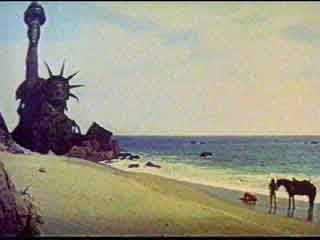
The movie opens to a spectacular monologue, delivered by Heston’s character, George Taylor, in which he details how he is the captain of a space ship who is out exploring the depths of space. Thanks to some scientific mumbo jumbo, Taylor reveals that while only a couple months had passed for the crew, over 700 years had passed on Earth, meaning that everyone and everything the crew once knew was dead and gone. Taylor then goes into deep sleep, and the film then cuts to one of the coolest opening credit scenes I had ever seen. The music was absolutely spectacular. The credits pass, and the ship crash lands on a planet which, Taylor muses, is about 300 light years from Earth. The crew, minus the one female member, survives the crash and travel through what appears to be a barren desert wasteland. Over the course of this trek, we learn much about the crew members and their personalities and motivations. Eventually, the crew comes upon life, and soon discovers a population of primitive humans. Taylor’s character muses that with life this primitive, in 6 months the crew will be lording over the planet. The reverie is cut short when apes riding on horses and wielding guns bust onto the scene, and soon start killing and capturing all the humans they can get their hands on. One member (naturally, the black guy) is killed, and the other two are captured. We soon learn that the humans on this planet are mute and stupid, and that apes have a very low opinion of humans on this planet. The next hour or so of film involves Taylor struggling to show to the apes that he is intelligent, and therefore should be treated as an equal. After some time, he is deemed a mutant and is set to be executed. After mounting a daring escape, Taylor, with the help of some sympathetic chimpanzees, flees to the so-called “forbidden zone” to find proof of intelligent humans existing before the apes. This proof is discovered, but the religious leaders of the ape society still do not want to accept that humans are equal to apes, and so the evidence is destroyed, though Taylor is set free. Taylor rides off, and, in one of the biggest twists in film, sees a half-buried Statue of Liberty, showing that he has been on Earth the whole time.

The cinematography and directing in this film is simply superb. Director Franklin J. Schaffner does a simply superb job with long sweeping shots, showing the viewer the true scope of the planet when the crew is travelling through the barren wasteland. I love the way the film goes from showing the individual actors, to cutting back to show the viewer the full scope of the region. It tells you more than any words can, and that is the scene of a truly great movie. Another excellent technique the film uses is quick jumps from mystery to blatant showing. What I mean, is best shown through the first scene in which the apes are seen. When the apes first start attacking the humans, we don’t see the apes for many minutes. All we can really see are the horses they are riding, and the tips of the threshers they are holding peaking over the corn fields. This continues for many minutes so that we don’t actually know what is chasing the humans, until, suddenly the film starts showing us. What I like about when they finally show us the apes, is that it is done very casually. The film suddenly goes from showing us nothing at all, to showing us the apes as though it’s been showing them to us the whole time. It’s very natural and done very well.

The acting in this film is…interesting to put it lightly. While there are some good scenes with the two other crew members, and the actor playing Dr. Zaius does a very good job for example, the focus is on Heston and his performance. What’s interesting about Heston’s character is that in any other actor I would call it gross overacting, and it really is. He’s hammy and cheesy, but the thing is, Heston has such a presence, such a gravitas that it really works for him. Though his delivery is on the whole very cheesy, it is actually remarkably compelling, and I actually really liked the cheese. What’s interesting is that many of the other characters are equally cheesy, ham and cheese would probably be the best description of the performances in this movie, but the thing is Heston as the large ham, and the movie’s over the top character just make the ham and cheese work, flat out.

Another thing about this film that really works is the makeup. The way in which real actors were rendered to look like apes in the days before green screen, before the days of Avatar technology, and before computer rendering technology is just really well done. You actually don’t realize that it really is a real human underneath all that hair.

The thing that really made the film for me though was the tension created throughout this film. Everything about this movie is exciting. From the chase scene in which Taylor and the crew are running from the apes, to Taylor’s dramatic discovery of the truth, you are constantly on the edge of your seat. What I like is that you really find yourself feeling for Taylor. You agonize over his inability to talk just as he does. You convince yourself that “if he could only just tell them who he is, then every will be sorted out.” What is more remarkable is that even though you know the truth, even though you know the ending of the film, you completely forget about it through the course of the film. It really is an excellent accomplishment.

With all this praise, however, I do have a couple complaints. One thing I didn’t like was the young chimp Lucius, who only comes into the film towards the end when Taylor escapes to the forbidden zone. I believe he is supposed to show the jaded, cynical youth of the chimpanzees, to demonstrate that the apes really are no different than humans, but he really just comes off as obnoxious, and I felt the film could have been much better without him. There were also a couple scenes that I felt were a bit superfluous to the film as a whole, for example Taylor’s first attempt at escape from town was way too drawn out, and if these scenes were cut down, the film as a whole could have been much better streamlined and paced a little better. However, these are really little more than nitpicks, rather than actual complaints.

Finally, the themes of this film are superb. This movie, at its most fundamental is on the first part about the importance of science, reason, and doubt, and also the importance of keeping science separate from religion. On the second part, the film is about the haughtiness of man, and a warning against the hubris of man being his major failing. One thing I find most interesting that best demonstrates this point is when Taylor finally reveals what the mission of the crewmen was. Their mission was a so called “Adam and Eve” played out in reality, in which the three male crewmen and one female would land on a new planet and repopulate human life on the new planet, with the idea of creating an Earth colony. When one thinks about this mission logically, they will immediately realize the idiocy not only of just sending 4 people on their own without communication to just arbitrarily find an hospitable planet to settle on, but to think that 3 men and 1 woman would be able to successfully create a new population. This mission shows that, in spite of Taylors sweeping anti-religious rhetoric, science and religion were blending on Earth as well. Finally, this movie is also about man’s penchant for destruction. One of my favorite lines in this film comes from the Orangutan cleric Dr. Zaius:

“Beware the beast Man, for he is the Devil's pawn. Alone among God's primates, he kills for sport or lust or greed. Yea, he will murder his brother to possess his brother's land. Let him not breed in great numbers, for he will make a desert of his home and yours. Shun him; drive him back into his jungle lair, for he is the harbinger of death. “

Finally, I can’t help pointing out the irony of Charlton Heston, today a major proponent of creation science and religious fundamentalism, in his youth doing a movie that is strictly anti-religion and pro evolution. Nevertheless this film is simply stupendous and definitely worth multiple watches. I am really glad I watched this film as rewatching it now has completely changed my opinion both of the movie and the series as a whole.
Read More
Posted in | No comments

Friday, January 7, 2011

#21 Seven Samurai (1954)

Posted on 5:52 PM by Unknown

Seven Samurai (1954)

"A brilliant epic"

A defenseless village is beset by bandits, who vow they will return in several months’ time to finish the pathetic town off for good. With no soldiers or strongmen of their own, and no means to defend themselves, the hopeless villagers pool all the remnants of their money together and travel to the local town to try to hire a band of soldiers to defend the village for them. With their meager savings, the villagers manage to wrangle together a rag tag bunch of old, scrappy men who, against all odds, manage to finally hold off the attack, saving the village for good. This age-old story is one that is well known to just about anyone with access to a television or modern popular culture, and it is most well done in Akira Kurosawa’s brilliant 1954 film “Seven Samurai”. This epic is stupendously shot, brilliantly acted, and absolutely ranks among the best films of all time.

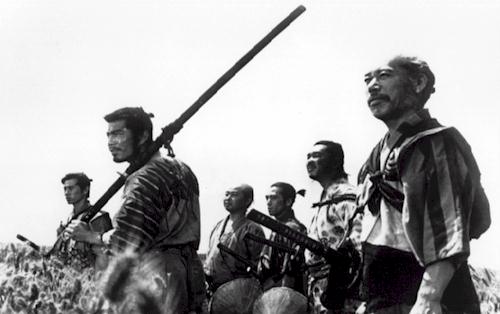
The story of the film is essentially what was listed above. A gang of bandits attacked a small, poor village, and decided that, since the village has already been raided, the bandits should return in several months’ time after the harvest to take whatever the villagers have left. Destitute and desperate, the villagers turn to the elder, who advise the villagers to travel to a nearby town to collect some samurai to defend them. After many short fallings and failure, the villagers manage to gain the allegiance of Shimada Kambei, a clever, wizened old samurai who has seen his fair share of battle. Through sheer force of will, Kambei manages to enlist the aid of 6 other samurai, all with their own select skills and abilities that make for a formidable force which manage to successfully stave off the numerous attacks of the bandits.

The film was directed by legendary Japanese filmmaker Akira Kurosawa, who was a monumental force not just in Japanese film, but in action film in general, creating many tropes, styles, and methods which would come to be staples in the Western and Action genres even up until today. You can see many of these styles today as the film is just spectacularly shot and directed. There are many cool scenes in this film. My personal favorite is when one of the samurai, Kyuzo duels with a challenger in a scene that has been copied so many times that it is certainly a cliché now. The two samurai stand opposed, gauging each other’s skills, each changing his stance periodically. Finally, the challenger makes his attack, and Kyuzo cuts him down with incredible ease. He then sheathes his sword and walks away. It was a powerful scene, made all the more poignant by the silence that encompasses the whole of it. I also love the minimalism of the film. Another thing I really like about the way the film is shot is the abrupt shifts from scene to scene. At first it’s a little jarring, but once you get used to it, the way Kurosawa shifts from saying what’s going to happen, to showing it happening is very artfully done, and on the whole makes the film all the better.

The film is not just well directed and shot, but is also very skillfully acted. Each of the samurai is very unique in their personalities, and it is all very well shown. From the quiet intensity of the master samurai Kyuzo (Seiji Miyaguchi), to the powerful leadership and gravitas carried by Shimada Kambei, played by Takashi Shimura, to the naïve optimism of Ohamoto Katsuhiro (Isao Kimura), to the doting, almost fatherly characteristics of Shichiroji (Daisuke Kato), all of these actors play their roles stupendously. The real show stealer of the movie, however, was the lowly peasant-born masquerading as a samurai named Kikuchiyo, who is played by the legendary actor Toshiro Mifune. Toshiro plays the role to perfection, showing the cynicism of the character, while also at all times displaying the deep seated loathing of the class from whence he came, and the constant attempts to be something he is not, it is all done so well, words cannot aptly describe the true skill with which this role is played.

What I truly love above all, however, are the themes shown in this movie. I watched this movie at the same time as I was taking a class on the history of the Tokugawa Era of Japan, a time in which the era of the samurai or more specifically, the ronin as is popularly envisaged was coming to an end, and that is what this movie encapsulates. This movie deals with pride versus honor, with the first couple samurai who were approached by the peasants turning the villagers down out of hand because they were peasants and had no money. The samurai who do take up the plight of the villagers, on the other hand, come to their aid out of pity for the villagers, in the case of Shimada Kambei or else a naïve ideal of honor and bushido, in the case of Ohamoto Katsuhiro, or finally, out of desire to fight and test ones skills, in the case of Kyuzo.

At the same time, the film investigates the plight of the villagers, who saw no difference between the robbing of their harvests by the bandits, and the robbing of their harvests by the bakufu, who refused to provide protection when asked anyway. However simultaneously through Kikuchiyo, we are shown that the “honest and defenseless villager” is not as defenseless and honorable as we are led to believe, though the villager is also shown to be justified in his actions.

Ultimately, however, the film is about the death of Japan, represented by the samurai. This film was released in 1954, which was in the thick of the postwar period, a time of deep shame and humiliation for the Japanese, who witnessed the emasculation of their once mighty empire, and their subordination to the Americans. All of these sentiments are displayed in the movie as the real losers in the film are the samurai; four of the seven are killed, but not just killed, but shot down by muskets, a symbol of advancement and changing times; the era of the sword was coming to an end. One of the survivors of the fight, Ohamoto Katsuhiro, the young, naïve, optimistic young samurai who idolizes the samurai he fights alongside throughout the battle, is left jaded and cynical by the senseless killing he witnesses, and by the loss of the love he finds in the village. Katsuhiro represents the jaded sentiments of the generation following the Second World War, and the true defeat of the Japanese people. The final line of the film, delivered by the other two surviving samurai, Shimada Kambei to Shichiroji is the most important:

Kambei Shimada: “So. Again we are defeated.”
[Shichiroji looks puzzled at Kambei]
Kambei Shimada: “The farmers have won. Not us.”

This truly is a remarkable piece of work, and is definitely one of the best I have seen so far. The wonderful directing, combined with the stupendous acting, bottled together into a wonderfully told story make for filmmaking magic. Though the film may seem long , coming in at nearly 4 hours, it is engaging for every minute of it, and by the end, I was at the edge of my seat. The film starts slow, but picks up momentum at such a rate that you hardly notice yourself falling in love with it. This movie is truly a must see for just about anyone, really.
Read More
Posted in | No comments

Wednesday, January 5, 2011

#20 Butch Cassidy and the Sundance Kid (1969)

Posted on 5:40 PM by Unknown

Butch Cassidy and the Sundance Kid (1969)

Sorry for the delay in getting the next movie on the list up again. I’ve been getting rather lazy lately, and I’m hoping to fix that now. Ideally I’m going to build up a nice reserve of movies reviewed so that making deadlines will not be so hectic to me (usually these reviews are being written literally 10 minutes before they are posted. Anyway, our movie for today is Butch Cassidy and the Sundance Kid, a western action- comedy starring Robert Redford and Paul Newman. Unfortunately, I’m writing this review a month and a half after having seen the film, but it’s still pretty firm in my mind. I’m just going to go ahead and say now that I really, really liked this film. The great chemistry between Redford and Newman, the excellent dialogue, and the interesting take on the “buddy cop” film genre (Which hadn’t actually started yet) that this movie plays at really are what make this movie one of the best I’ve seen off this list (I know, I say that a lot).

This movie takes place in the late 1890s during the Spanish-American War in, what is presumably the American Southwest. The Hole in the Wall gang, led by Butch Cassidy (Paul Newman) and the Sundance Kid (Robert Redford) are making a name for themselves as robbers of repute. The story starts with a sort of “silent film” which sets the story of the film, setting up the “legend of Butch Cassidy and the Sundance Kid”. The film then takes us straight to the action, with the two sitting in a saloon when they are approached by a man who challenges them to a duel, resulting in the Sundance Kid showing off his skills with a pistol. What I found interesting about this scene was that the whole thing was filmed in black and white, obviously trying to play itself into the classic “old west” films. The film then switches into color, and from there the movie starts to actually develop the story, with the two banditos robbing trains, then being chased across the southwest, then fleeing to the East, then fleeing to Bolivia, and trying to make ends me there. All the while the two of them are making snarky remarks at one another and vying for the hand of the romantic interest of the film – Etta Place, played by Katharine Ross.

One thing I really like about this film is the way in which the movie makes everything feel really surreal. You the viewer never truly feels that the two of them are in danger of being killed, even though that risk is great throughout most of the movie. The other thing I love about this movie is just how quotable it is. This movie has so many great lines, and the majority of my notes consist of writing down lines from the film.

As I’m implying above, I thoroughly loved the performances given by Newman, Redford, and Ross. Newman (The Brains of the Operation) and Redford (The skilled marksman) had such great chemistry together, and their timing and delivery of lines was absolutely stupendous. Everything about them in this film just flat out worked. I thought the direction of this film was also quite good. I liked the way the director George Roy Hill plays with different film methods, with the grainy silent film in the beginning, the shift to black and white, and then to color, and even more I liked the play with the montage about the trio’s experiences in New York, told through old-timey photographs. I also like Hill’s decision to not translate the Spanish used in the film when the trio travels to Bolivia, for those who don’t speak Spanish, it puts the viewer in the same position as the trio, facing a severe language barrier, and gives a nice bilingual bonus to those who do speak the language.

The Cinematography in this film is also stupendous, particularly the epic long shots in the film which really gives you a sense of the scale and epicness of the terrain that we’re talking about. The most striking scene to me is the last scene of the film, when Butch and the Sundance Kid run into what is essentially a firing squad when the military corners them in a small village in Bolivia. The shot is taken from the perspective of the army, taken far back, and you can see the two run out of the house they are taken cover in as the screen turns yellow, establishing two robbers as legendary figures, meanwhile in the background you can hear shots fired in unison multiple times.

The music in this film was also quite good. The mixture of western-ey sounds, with abrupt, almost random stops and shifts to different genres initially feels very scattered, but actually works very well with the film as a whole. Not to mention this film has that famous song “Raindrops Keep Falling on my Head” which is a very well known (and awesome) song .

This truly is an awesome film, and I imagine it is on the list for a number of reasons. The first I’d say, is for the film’s ability to blend comedy and action into a film that is truly entertaining from start to finish. The second is probably because of its great influence not just on film, but on pop culture (many of the lines in this film are still repeated, and who hasn’t sung Raindrops Keep Falling on my Head before?). This film is almost certainly on the list because of the incredible chemistry between Redford and Newman, two of the monolithic action/drama stars of that era, and the two of them together, working so well together, is probably one of the best male-male actor pairings of all time. Finally, I’d say that this film is on the list because, arguably, this is the first buddy cop film ever. Even though the movie is about banditos, the film really does lay down a lot of the tropes and characteristics that make up a buddy cop film, making it exceedingly influential as an important film. This truly great film really is a must see for everyone.
Read More
Posted in | No comments
Newer Posts Older Posts Home
Subscribe to: Posts (Atom)

Popular Posts

  • #17 Dracula (1931)
    Although the connotations of the concept and name “vampire” have changed massively in the last decade, especially with the advent of the po...
  • #41 Sherlock Jr. (1924)
    Sherlock Jr (1924) So here I am, sitting down in Mid-August to write the first of 6 reviews for movies I watched way back in March. Needless...
  • #16 Nosferatu, eine Symphonie des Grauens (1922)
    "A Key Work in the history of film" It can be argued that there is no story or character more adapted and done in film than vampi...
  • The Exorcist (1973)
    The Exorcist (1973) The Exorcist is a movie which has evoked the fears of every child and young adult (and even some adults) for the past n...
  • #21 Seven Samurai (1954)
    Seven Samurai (1954) "A brilliant epic" A defenseless village is beset by bandits, who vow they will return in several months’ ti...
  • The Shining (1980)
    The Shining (1980) The Shining is one of those quintessential movies. So many things from this movie are referenced, quoted, or even outrig...
  • Citizen Kane (1941)
    What can be said about Citizen Kane that hasn’t already been said a thousand times over? The Orson Welles classic about a rich newspaper mog...
  • #34 The Haunting (1963)
    The Haunting (1963) “Hill House has stood for 90 years and might stand for 90 more. Within, walls continue upright, bricks meet, floors are ...
  • Pather Panchalli (1955)
    Pather Panchali (1955) What comes to mind when you first think of India? Let me guess, caste systems, jungles, elephants, and snake charmers...
  • #37 Kind Hearts and Coronets (1949)
    Kind Hearts and Coronets (1949) "It is so difficult to make a neat job of killing people with whom one is not on friendly terms." ...

Categories

  • Citizen Kane
  • Clint Eastwood
  • Dirty Harry
  • Duck Soup
  • film reviews
  • great movies
  • Marx Brothers
  • Orson Welles
  • Rosebud

Blog Archive

  • ▼  2011 (22)
    • ▼  October (2)
      • #41 Sherlock Jr. (1924)
      • #40 Our Hospitality (1923)
    • ►  April (1)
    • ►  March (1)
    • ►  February (6)
    • ►  January (12)
  • ►  2010 (20)
    • ►  October (1)
    • ►  June (2)
    • ►  May (10)
    • ►  April (7)
Powered by Blogger.

About Me

Unknown
View my complete profile